
Disclosure: As an Amazon Associate, I earn from qualifying purchases. This technical review contains affiliate links which support our research at no cost to you.
If you want to build a versatile home gym but only have a small corner of space to work with, a traditional, bulky cable crossover machine is usually out of the question. A wall mounted cable machine solves this spatial problem by bringing the utility of a commercial cable station into a narrow, vertical design that anchors directly to your wall.
These compact vertical systems provide a space-efficient way to add isolation movements, unilateral training, and joint-friendly resistance curves to your routine. In this technical review, we break down the safety, cost, and physical realities of buying a wall mounted cable machine so you can choose the correct setup for your home space.
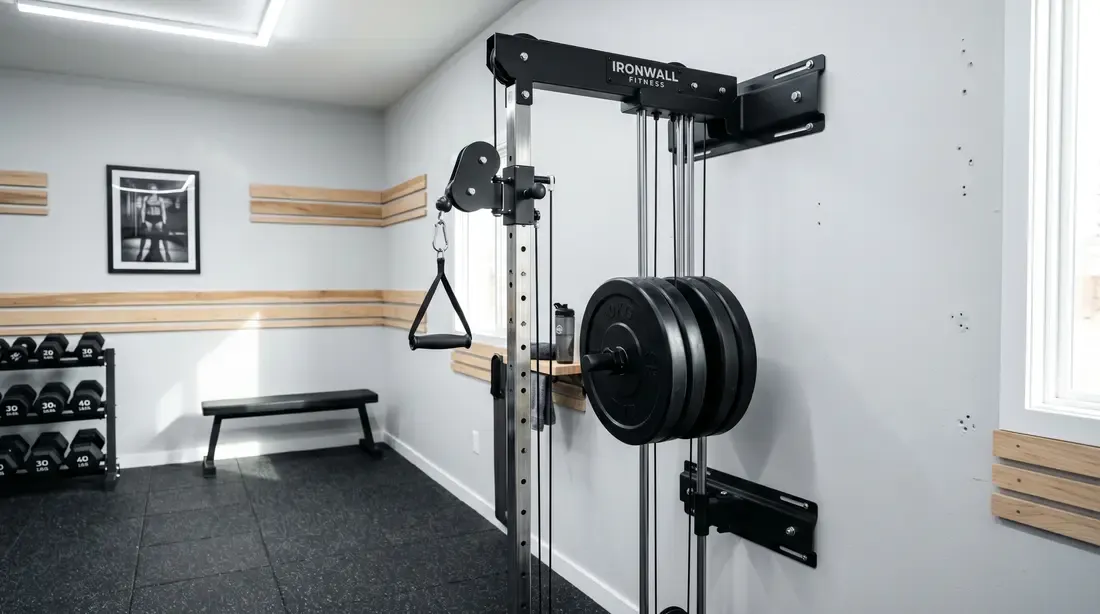
Wall-mounted cable systems offer commercial-grade unilateral training in a vertical format that takes up less than 3 square feet of floor space. Key purchasing decisions center on selecting a plate-loaded slide trolley (budget-friendly) versus a selectorized pin-loaded weight stack (fast adjustments), and verifying that you have solid wood studs or masonry to support the load.
A step-by-step structural walkthrough on finding wood studs, concrete anchoring, and ledger board workarounds.
An analytical look at guide-rod friction, 1:1 vs. 2:1 pulley ratios, and setup speed during workouts.
Alternative door-mounted, suspension, and suction systems for apartments where drilling is not allowed.
The ergonomic differences between standard handles, multi-grip lat bars, and extra-long tricep ropes.
1.0 Wall-Mounted Pulleys Maximize Floor Space Efficiency
Traditional functional trainers rely on dual-weight stack triangular footprints that often require twenty-five square feet of floor space. They are designed for large commercial spaces and often dominate a standard bedroom or small garage.
Compact wall-mounted pulley towers consolidate this motion into a single vertical track with adjustable pulley carriages, keeping the entire machine’s footprint within three square feet. This design allows you to perform cable flies, lat pulldowns, and low rows in tight corners without sacrificing floor area.
2.0 The 2:1 Pulley Ratio Halves Your Working Load
Most compact wall systems utilize a 2:1 pulley ratio. This means that loading 100 pounds on the carriage yields 50 pounds of actual cable resistance. While this might seem like a drawback for heavy lifting, it provides double the cable travel length (typically up to 8 feet) and keeps the movement highly fluid and consistent.
To understand the physics of mechanical tension, cable travel length, and how certain systems can convert to a 1:1 ratio, check out our comprehensive guide: Plate-Loaded vs. Selectorized Systems Performance Analysis.
3.0 Dual Independent Cables Support Balanced Training
High-quality cable machines feature dual independent cable lines rather than a single coupled cable. This design supports unilateral training, allowing you to work both arms independently to prevent strength imbalances. With dual lines, the resistance remains balanced on both sides, making it an excellent tool for correcting postural issues or rehabbing injuries.

Performing a unilateral chest press with smooth 2:1 pulley line extension and neutral grip leverage.
4.0 Wood Stud and Masonry Anchoring is Non-Negotiable
Because cable machines generate substantial pull-out forces during movements like face pulls and rows, solid wall mounting is critical for safety. The upper and lower brackets must be secured directly into wooden wall studs or solid brick/concrete walls using heavy-duty lag bolts.
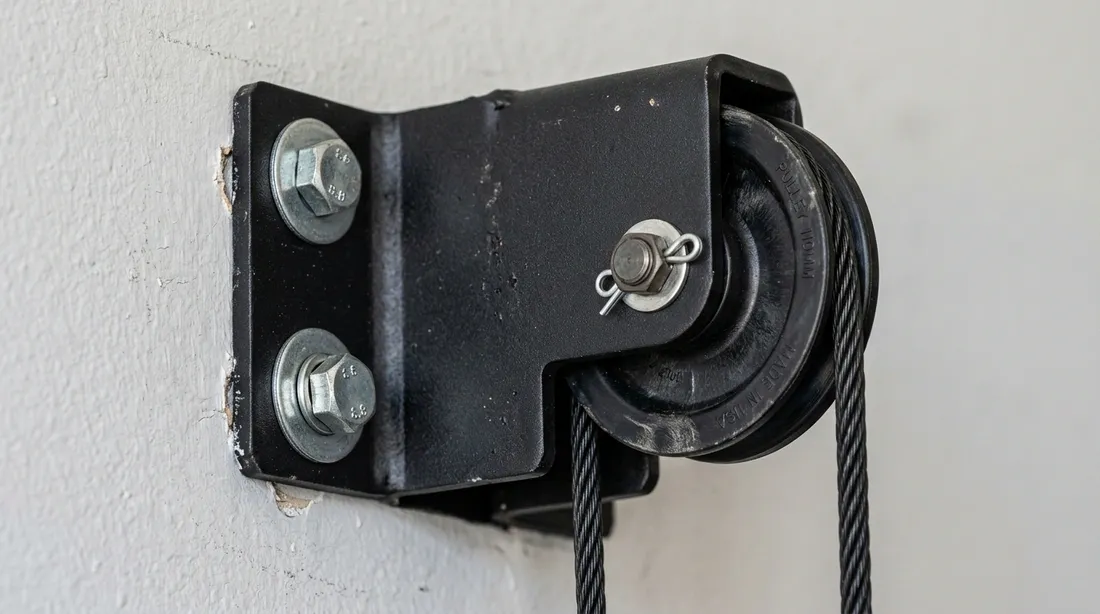
Anchoring bracket bolted securely to a wood stud with heavy-duty lag screws and structural washers.
Never rely on drywall anchors to secure a cable tower. The vertical and horizontal pull forces will pull the bracket out, causing structural damage or injury. For a step-by-step mounting guide, visit our Wall-Mounted Pulley Tower Installation & Structural Safety Guide.
5.0 Plate-Loaded Trolleys Can Introduce Guide Rod Drag
Plate-loaded options allow you to use your existing Olympic or standard weight plates, making them highly budget-friendly. However, the plate carriage sliding over steel guide rods can sometimes introduce physical drag compared to selectorized stacks. Applying a dry silicone spray to the guide rods every three months helps maintain low-friction sliding and prevents the carriage from sticking during movements.
6.0 Selectorized Stacks Offer Unmatched Setup Speed
Selectorized systems utilize a built-in steel weight stack, allowing you to quickly change loads during training using a magnetic selector pin. This setup is ideal for rapid drop-sets and super-sets, though it carries a cost premium (often $300–$500 more than plate-loaded equivalents).
7.0 Upgraded Components Maximize System Lifespan
Budget-friendly towers often come with basic nylon pulley wheels. Over time, heavy use can cause the steel cable to wear down these plastic components. Upgrading to CNC-machined aluminum pulley wheels reduces friction and extends the life of the steel cable, keeping your machine running quietly and smoothly.
Technical Specifications Comparison
The table below outlines the mechanical parameters of the top wall-mounted pulley systems. Swipe horizontally on mobile devices to view all technical data:
| Specification Factor | Bells of Steel Cable Tower 2.0 | Titan Fitness Tall Pulley Tower V3 | Valor Fitness BD-62 Station |
|---|---|---|---|
| Load Style | Weight Stack (210 lbs) or Plate-Loaded | Plate-Loaded (Sleeves included) | Plate-Loaded (1″ posts) |
| Maximum Weight Capacity | Dependent on stack load or plate count | 350 lbs | 200 lbs |
| Dimensions (D x W x H) | 28.5″ x 25.1″ x 80.9″ | 28.0″ x 25.0″ x 84.5″ | 24.0″ x 22.0″ x 80.0″ |
| Pulley Ratio | 2:1 (Option for 1:1 with adapter) | 2:1 (Option for 1:1 with adapter) | Variable dynamic ratio based on pulley placement |
| Height Settings | 33 levels | 18 levels | 17 levels |
In-Depth Audits of the Best Wall-Mounted Pulley Towers
Bells of Steel Cable Tower (Weight Stack / Plate-Loaded 2.0)
This premium tower stands out due to its modular design, which is sized to match the dimensions of power rack uprights. This allows you to mount compatible rack attachments directly to the tower frame, maximizing gym utility.
- Heavy-Duty Guide Rods: Highly polished steel minimizes trolley slide resistance.
- Multiple Configuration Options: Available with a built-in 210-pound weight stack or as a plate-loaded option.
- 33 Height Adjustments: Offers highly detailed height positioning for precise biomechanical alignment.
- Excellent stability and high-quality welding.
- Compatible with power rack accessories.
- Can easily convert from 2:1 to 1:1 ratio.
- Commanding price point (especially for weight stack configuration).
- Step-by-step instructions can be brief for assembly.
Titan Fitness Tall Wall-Mounted Pulley Tower V3 (84.5″)
Titan Fitness delivers a robust, budget-friendly plate-loaded system with a solid 350-pound weight capacity. It includes standard-to-Olympic 2-inch adapter sleeves as standard equipment, making it highly versatile for home lifters.
- High Load Rating: Supports heavy strength work with a robust 350-pound capacity limit.
- Versatile Mounting: Can be bolted directly to walls or mounted to compatible power racks.
- Olympic Adapters Included: Features quick-change sleeves to accommodate standard or Olympic plates.
- Highly affordable price-to-weight performance.
- Includes 2-inch Olympic adapter sleeves in the box.
- Includes ergonomic dual stirrup handles.
- Trolley carriage slider can require regular silicone lubrication to prevent drag.
- Wall mounting bolts are not included in the standard hardware package.
Valor Fitness BD-62 Wall Mount Cable Station
The Valor BD-62 utilizes a dual-pulley track layout, providing a smooth gliding movement for bilateral and unilateral training. Its compact design and stable double-bar track make it a highly practical option for tight spaces.
- Dual-Track Carriage: The dual-bar track design prevents carriage twist during workouts.
- 17 Height Positions: Provides plenty of adjustment options for diverse exercises.
- Sleek Footprint: Extends minimally into active workout spaces.
- Dual independent pulley lines support bilateral arm movements.
- Very compact frame with durable strap handles included.
- High value for tight, compact spaces.
- Maximum load capacity is capped at 200 pounds.
- Requires a separate purchase of 2-inch adapter sleeves for Olympic plates.
Frequently Asked Questions
Standard metal studs are typically too thin to support the pull-out forces generated by a cable tower. If you must mount to metal studs, a plywood header board must be anchored across multiple studs first to distribute the dynamic load safely.
A 2:1 ratio provides double the cable travel length and a smoother, more fluid movement, which is highly beneficial for fast exercises like sports-performance drills and rehabilitation movements. A 1:1 ratio is better suited for heavy, slower compound lifts.
Cables should be inspected monthly for any signs of outer coating wear, splitting, or internal wire fraying. In home gym environments, cables should typically be replaced every 2 to 3 years to ensure safety.