
Disclosure: As an Amazon Associate, I earn from qualifying purchases. This technical review contains affiliate links which support our research at no cost to you.
When planning your cable station space, the primary hardware choice centers on a plate loaded vs selectorized cable machine configuration. Deciding how your system holds and adjusts resistance directly dictates your exercise transition speed, overall financial budget, and the consistency of the resistance profile.
In this comparative review, we break down the physics of a plate loaded vs selectorized cable machine, analyzing cable drag, weight carriage stability, and pulley ratios. We evaluate how weight stack inertia impacts your workouts to help you make an informed decision for your home training facility.
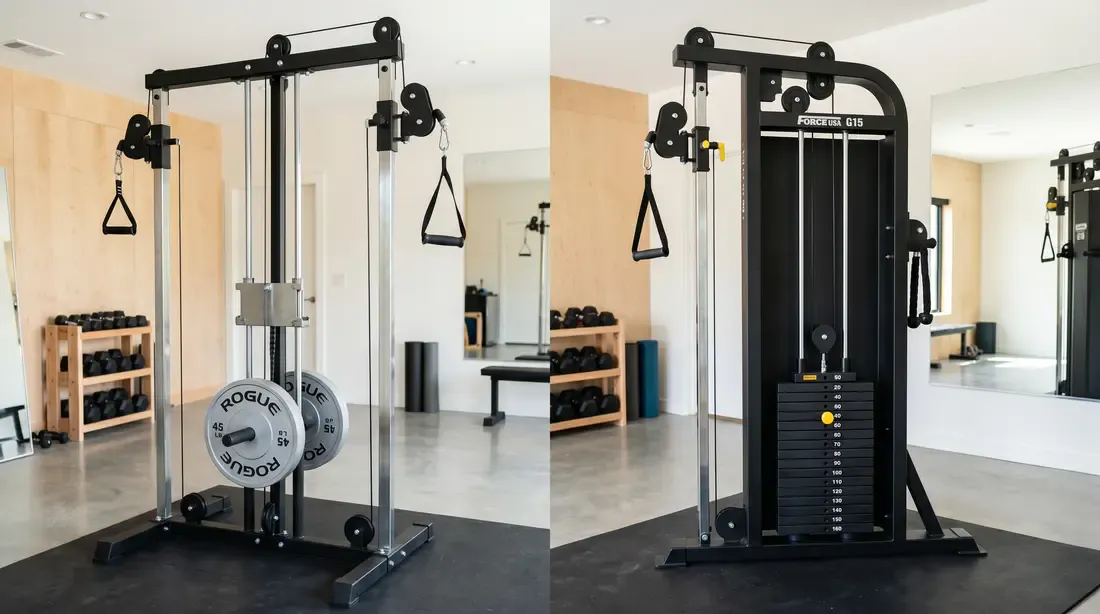
Choose a plate-loaded cable machine if you already own Olympic weight plates and want to keep equipment costs low. Choose a selectorized cable machine if you prioritize rapid resistance changes during drop-sets and want a completely uniform slide motion with zero weight sleeve loading required.
Access our main wall mounted cable machine buying guide to compare top models, specs, and price ranges.
Read our detailed guidelines on wood stud mapping, lag bolts, and ledger boards to perform a safe wall installation.
Explore door anchors and suction mounts using our renter-friendly cable machine alternatives.
Review the best ergonomic lat bars, d-handles, and ropes to maximize structural back isolation.
1.0 The Weight Interface: Slide Carriage vs. Selectorized Stack
A plate-loaded cable tower uses a sliding metal carriage equipped with horizontal weight horns. You must manually slide standard 1-inch or 2-inch Olympic weight plates onto these horns to create resistance.
Conversely, selectorized systems feature a permanent, vertical stack of rectangular steel plates. To adjust the load, you simply insert a magnetic metal selector pin into the corresponding slot, engaging the internal guide shaft instantly.
2.0 Pulley Ratio Physics: Demystifying 1:1 vs. 2:1 Tension
Pulley ratios define the mechanical advantage of the cable routing. Many home pulley towers feature a 2:1 pulley ratio, which splits the actual weight stack load in half at the handle.
For example, loading 100 pounds on a 2:1 system results in 50 pounds of actual tension. This design is common because it provides double the cable travel length (typically up to 8 feet) and keeps the movement highly fluid and consistent.
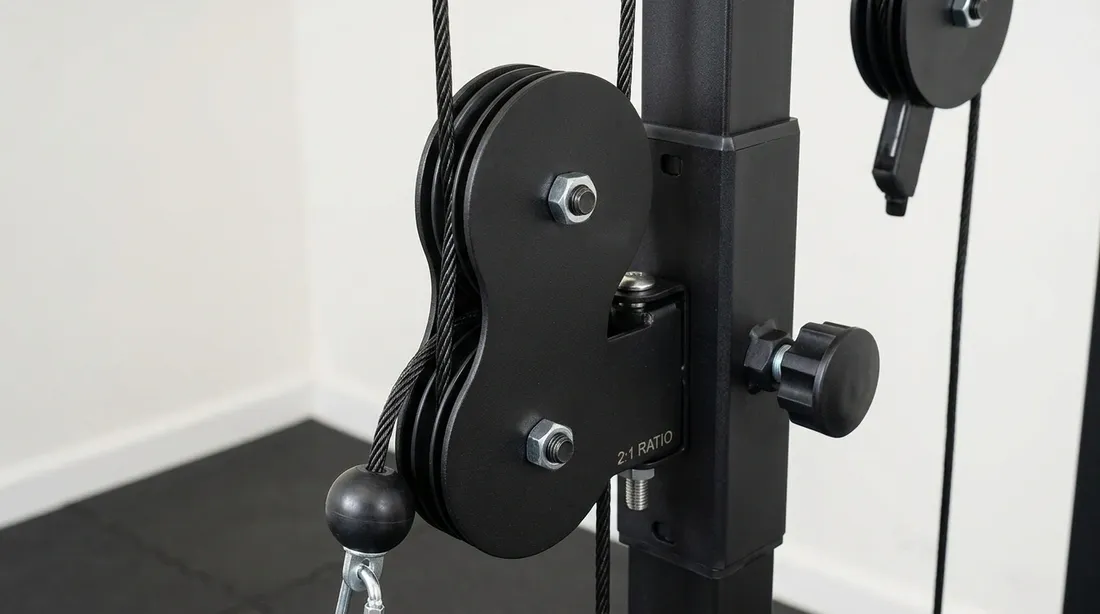
A 2:1 pulley system routes the cable through a traveling block carriage to increase cable travel length and smooth the movement curve.
3.0 Guide Rod Friction: Managing the Carriage Drag
Plate-loaded slide carriages slide along dual steel guide rods. Because the carriage is wide, any uneven weight loading can cause the carriage to twist slightly, creating physical friction (drag) as it slides along the rods.
Selectorized stacks avoid this issue because the weight plates are carefully centered on the guide rods. Applying a dry silicone lubricant to the guide rods every three months helps maintain low-friction sliding on plate-loaded systems.
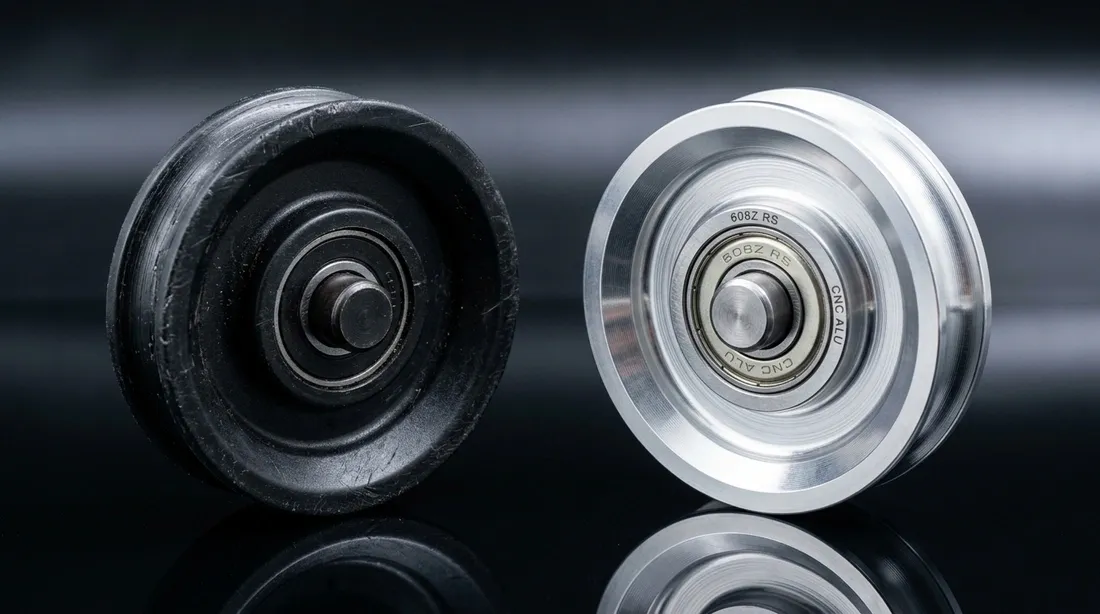
Upgrading standard nylon plastic pulleys to high-grade aluminum wheels with sealed ball bearings helps reduce carriage friction.
4.0 Footprint and Spatial Constraints of Stacks
Plate-loaded machines require extra lateral space so you can safely slide weight plates onto the storage horns. This means you must leave at least 12 to 18 inches of clearance on both sides of the machine.
Selectorized stacks are much more compact. Because the weights adjust vertically within the frame, the machine can be placed flush into tight corners or narrow spaces without requiring side clearance.
5.0 The Financial Equation: Price-to-Utility Ratio
Plate-loaded pulley towers are highly cost-efficient because you are not paying for heavy steel blocks. This makes them a highly popular choice for lifters who already own a collection of Olympic plates.
Selectorized units carry a premium price due to the manufacturing and shipping costs of 150 to 200+ pounds of solid steel. They represent a long-term home gym investment designed for high-frequency use.
6.0 Inertia and Resistance Profiles during Reps
During explosive movements, heavy weight plates on a plate loader can generate momentum, causing the cable to go slack at the top of the rep. This momentum effect can lead to an uneven, jerky resistance profile.
Selectorized weight plates are designed to move smoothly on dual guide rods, which helps control this inertia. This consistent tracking ensures that your muscles stay under steady, uniform tension throughout the entire range of motion.
7.0 Conversions and Upgrades: Adapting Plate Systems
If you choose a plate-loaded tower, you can easily upgrade its performance over time. Standard 1-inch plate horns can be fitted with 2-inch adapter sleeves to securely hold Olympic plates.
You can also replace standard nylon pulleys with CNC-machined aluminum pulleys to reduce drag, or use a gym pin adapter to add micro-weights to a selectorized weight stack.
Structural Comparison Matrix
The following table outlines the mechanical parameters of both weight systems. Swipe horizontally on mobile devices to review all technical data:
| Performance Parameter | Plate-Loaded Pulley Systems | Selectorized Weight Stack Systems |
|---|---|---|
| Average Hardware Cost | Low ($180 – $250) | High ($500 – $850+) |
| Adjustment Speed | Slow; requires manual plate loading and locking | Near-Instant; simple magnetic selector pin insertion |
| Guide Rod Drag Profile | Subject to friction if plates are unbalanced | Extremely smooth; weights are centered on guide rods |
| Lateral Space Required | Requires side clearance to load and unload plates | Zero side clearance; adjustments are fully vertical |
| Inertia Slack on Fast Reps | Moderate; high-velocity lifts can cause temporary slack | Low; vertical tracking controls acceleration force |
Recommended Upgrades for Cable Towers
If you are using a plate-loaded system, utilizing these highly precise accessory upgrades can help elevate its sliding smoothness closer to a commercial-grade feel.
Titan Fitness 9-Inch Olympic Adapter Sleeves (Pair)
This high-quality pair of adapter sleeves converts standard 1-inch post horns to standard 2-inch Olympic size weight posts. Constructed from durable nylon, each sleeve is 9 inches long, 1.9 inches in diameter, and holds a secure, snug grip via an integrated steel hex lock bolt.
- Durable Nylon Construction: Designed to provide a secure grip and slide surface for heavy plates.
- Hex Lock Bolt Anchor: Simply slide on and tighten with the included Allen wrench to secure.
- Convenient Pair Pack: Contains two matching 9″ sleeves to convert both standard post horns.
- Converts standard 1-inch bars to fit 2-inch Olympic plates.
- Sleeve length holds multiple thick plates securely.
- Hex lock bolt set screw ensures a slip-free fit.
- Requires periodic tightening of the hex lock bolt.
- Not compatible with threaded 1-inch bars.
CNC Aluminum Pulley Wheels Upgrade Kit (90mm)
This universal aluminum pulley wheel kit is designed to replace factory nylon plastic wheels. Engineered with robust CNC-machined aluminum alloy and premium sealed double carbon steel ball bearings, this 90mm upgrade delivers quiet, smooth rotation and reduces dynamic cable drag.
- CNC-Machined 6061-T6 Aluminum: Structural durability prevents grooves, flat spots, or cracks.
- Double Sealed Ball Bearings: Offers low-resistance friction rotation under high loads.
- Universal 90mm (3.54″) Profile: Universally sized to fit standard home gym bracket housings.
- Sealed bearing design operates quietly and smoothly.
- Friction-free performance protects steel cables from sheath wear.
- Durable aluminum construction easily handles high weight capacities.
- Slightly heavier than standard nylon plastic pulley wheels.
- Requires socket tools and assembly time to replace existing pulleys.
Frequently Asked Questions
Technically, yes, but it is rarely cost-effective. Purchasing a standalone 150-pound weight stack and the correct guide rods often costs more than buying a complete selectorized unit from the start. We recommend choosing your preferred system from the beginning.
Neither is universally better; they simply serve different training goals. A 1:1 ratio is excellent for heavy compound movements like rows because you lift the exact weight loaded. A 2:1 ratio is better for isolation work like crossovers because it offers longer, smoother cable travel.
Always use a high-quality dry silicone spray or Teflon lubricant. Avoid wet oils, WD-40, or grease, as these attract dust and lint, which will clog the sliding carriage sleeves over time.
