
Disclosure: As an Amazon Associate, I earn from qualifying purchases. This technical review contains affiliate links which support our research at no cost to you.
For apartment renters and travelers, installing a permanent, bolted steel tower inside their home is rarely a viable option. Utilizing a highly functional portable resistance cable trainer no drill setup allows you to perform smooth unilateral and bilateral cable movements without leaving permanent lag-bolt marks in wood framing.
These non-invasive systems leverage door hinges, existing overhead bars, and high-traction friction clutches to generate resistance. In this technical review, we evaluate the safety parameters, dynamic load limits, and performance mechanics of the best portable resistance cable trainer no drill systems designed to preserve your home’s security deposit.
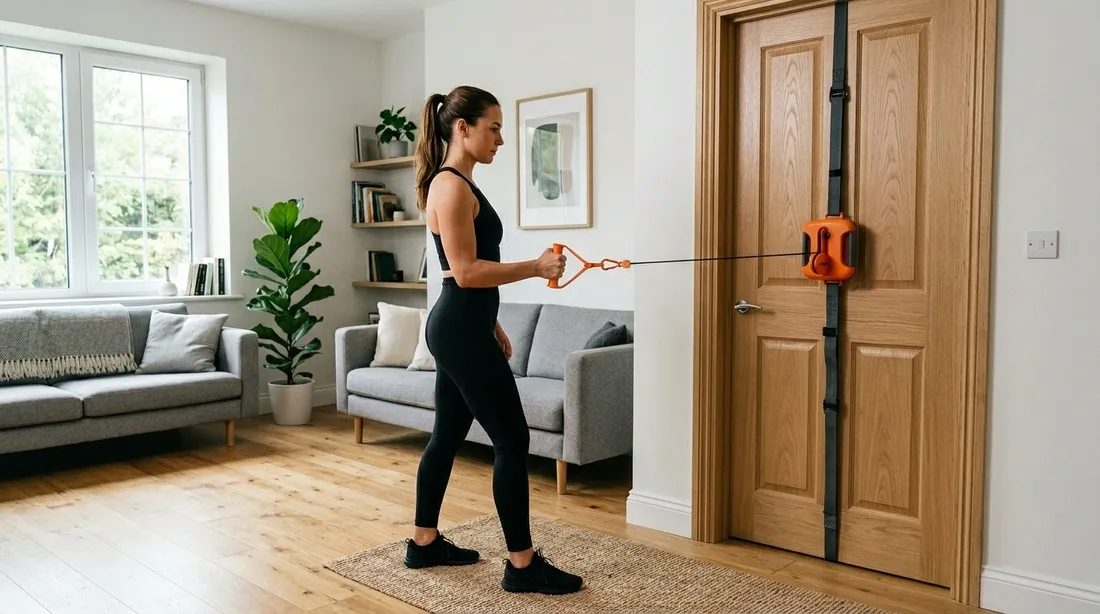
Renter-friendly cable training relies on two primary setups: door-mounted strap anchors that utilize the door frame’s structural strength, or suspended pulley systems that loop over an existing pull-up bar. For the ultimate space-saving experience, compact smart concentric cable clutches generate up to 300 lbs of resistance in a 9 lb package without requiring any wall mounting.
Access our main wall mounted cable machine buying guide to compare top models, specs, and price ranges.
Read our detailed guidelines on wood stud mapping, lag bolts, and ledger boards to perform a safe wall installation.
Compare the mechanical differences, pulley ratios, and guide-rod friction levels of plate-loaded vs. selectorized systems.
Review the best ergonomic lat bars, d-handles, and ropes to maximize structural back isolation.
1.0 The Renter’s Wall Dilemma: Preserving Your Security Deposit
Installing a standard wall-mounted pulley tower requires driving four to six thick lag bolts deep into wooden studs [1]. In rented apartments or temporary student housing, these structural modifications often violate lease terms, leading to costly drywall repairs.
No-drill fitness engineering bypasses this problem entirely. By utilizing door frames, gravity-assisted hanging straps, or standalone friction plates, you can train with cable-style resistance without leaving permanent holes in drywall.
2.0 Tension Vectors: How Door Anchors Leverage Frame Integrity
Door-mounted cable anchors use a thick, high-density nylon strap wrapped around the vertical or horizontal axis of a standard interior door. When the door is closed and latched, the wood door frame acts as a solid, structural brace.
To ensure safety, you must always perform exercises in the direction of the door’s closing swing. This direction pulls the door tighter against the frame jamb rather than putting force on the small latch mechanism, preventing accidental door opening.
3.0 Suspended Pulleys: Using Existing Overhead Bars
If you already own a sturdy doorway pull-up bar, you can easily install a suspended pulley system. This setup uses a heavy-duty strap to hang a silent pulley wheel from your existing bar, rafter, or power frame.
These systems are plate-loaded. You simply load standard or Olympic plates onto a vertical loading pin, connect the cable to the hanging pulley, and perform tricep pushdowns or lat pulldowns without drilling into any wall.
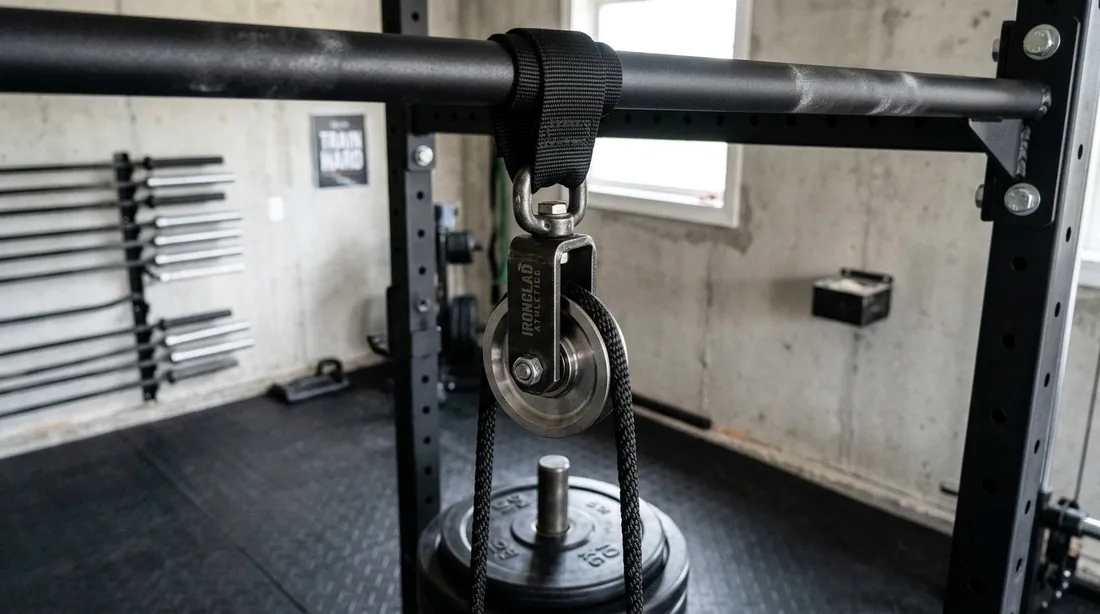
A hanging pulley loop attaches to any pre-existing horizontal bar, using gravity to suspend the weight plates safely.
4.0 Concentric Power Clutches: Cable Training in a 9-Pound Unit
The newest development in portable fitness is the concentric power clutch system. These compact devices weigh under 10 pounds and replace an entire weight stack by using a mechanical brake clutch.
These smart cable machines use ultra-strong polymer cords (often made of fibers 15x stronger than steel by weight) to provide up to 300 pounds of concentric resistance. You simply stand on the base plate or attach it to a door bracket to train without plates.

A portable smart cable unit uses internal brake friction to deliver high resistance without any physical weight plates.
5.0 Suction Cup Anchoring: Surface Science and Limits
Some portable systems utilize industrial-grade vacuum suction cups to mount to smooth surfaces like glass, tile, or polished varnished wood. These cups are highly convenient, but they require a completely non-porous surface to hold a secure vacuum seal.
Suction systems should only be used on highly durable surfaces like thick glass or concrete. Avoid using them on standard painted drywall, as the pull-out forces can easily tear the paper backing off the wall, causing the anchor to fail.
6.0 Safety Protocols for Temporary Cable Attachments
Because no-drill systems rely on friction, straps, or gravity, regular safety checks are essential. Before starting a workout, inspect all nylon straps for any signs of fraying, check that carabiners are securely locked, and verify that door anchors are fully seated behind the frame.
Check your hinges. Always verify that the door hinges are fully tight and showing no signs of play. A standard residential door hinge can handle bodyweight pull-forces, but worn, loose screws can pull out under high dynamic cable loads.
7.0 Maintenance Cycles for Nylon Straps and Webbing
Industrial nylon webbing is highly durable, but sweat, humidity, and constant friction can slowly wear down the fibers. Keep all door straps dry, clean them periodically with a mild damp cloth, and avoid letting the straps rub against sharp metal brackets during exercises.
No-Drill System Comparison
The table below outlines the mechanical parameters of top no-drill systems. Swipe horizontally on mobile devices to view all technical data:
| Performance Factor | Suspended Pulley Systems | Door-Mounted Strap Systems | Concentric Smart Cable Systems |
|---|---|---|---|
| Dynamic Resistance Limit | Typically 300 to 350 lbs | Dependent on band thickness (usually up to 150 lbs) | Up to 300 lbs of concentric resistance |
| Load Style | Manual Weight Plates (Plate-Loaded) | Elastic Resistance Bands or cords | Integrated Mechanical Brake Clutch |
| Portability Rating | Moderate; requires transporting physical plates | High; lightweight bands pack easily | Extremely High; entire unit weighs under 10 lbs |
| Installation Effort | Instant; loops over any existing pull-up bar | Quick; wraps around door and cinches tightly | Minimal; stands on floor or hooks to door strap |
| Exercise Versatility | Excellent for downward pulls (Pushdowns/Lat Pulls) | Good for multi-height standing movements | Excellent; supports full bar squats, presses, and rows |
Recommended No-Drill Cable Systems
Our review board has evaluated the performance, stability, and construction quality of the top renter-friendly systems designed to deliver smooth cable resistance without wall damage.
MAXPRO SmartConnect Portable Cable Machine
The MAXPRO SmartConnect is an exceptionally portable cable system that delivers up to 300 pounds of concentric resistance in a compact, 9-pound package. It uses built-in Bluetooth sensors to sync with your phone, tracking your repetitions, speed, and power output in real-time.
- Concentric Resistance Dial: Adjusts from 5 lbs to 300 lbs across 50 settings.
- Bluetooth Smart Tracking: Connects to the free MAXPRO coaching app to monitor your workouts.
- Aluminum Alloy Body: Heavy-duty construction paired with a high-impact PCABS compound.
- Replaces an entire rack of dumbbell weights in a small footprint.
- Concentric-only training provides smooth tension that is highly joint-friendly.
- Includes quick-connect long bar, workout handles, and door mount brackets.
- Does not provide eccentric (lowering) resistance; pull-only design.
- Higher premium cost compared to basic plate-loaded straps.
Taeku LAT Pulley System for Home Gym
The Taeku suspended pulley system is a highly affordable plate-loaded option for lifters who already own weight plates. This kit attaches to any standard pull-up bar or ceiling joist, allowing you to perform lat pulldowns and tricep pushdowns with smooth, gravity-driven resistance.
- Silent Steel Pulley: Heavy-duty bracket wheel runs quietly without cable friction.
- Nylon Coated Steel Cable: Durable high-strength cable with secure lock clamps.
- Highly Adaptable Hanging Loop: Connects to any standard pull-up bar or structural ceiling beam in seconds.
- Highly budget-friendly way to add pulley exercises to your home.
- Fits both standard 1-inch and 2-inch Olympic plates.
- Simple, quick assembly takes less than two minutes.
- Requires a sturdy overhead bar or frame to suspend the pulley.
- Not designed for bottom-up pulling movements (low rows).
Frequently Asked Questions
For heavy compound work, wall-bolted towers offer superior structural stability. However, high-quality no-drill systems—particularly door-anchored straps and floor-based concentric clutch units—are highly stable and secure when installed correctly.
A standard interior door frame can easily handle high pull forces if the strap is positioned on the hinge side of the door and you perform exercises in the direction of the door’s swing. This configuration distributes the load evenly across the door’s entire structure.
Yes, scientific studies show that concentric-only training (focusing only on the pulling phase of an exercise) is highly effective for building strength and muscle hypertrophy. It also reduces muscle damage and soreness, making it an excellent tool for quick recovery.
