Disclosure: As an Amazon Associate, I earn from qualifying purchases. This technical review contains affiliate links which support our research at no cost to you.
Adding photobiomodulation (PBM) to your athletic wellness routine is an excellent way to support joint and muscle health, but selecting the right hardware requires a technical evaluation of at home red light therapy panels.
Unlike simple heating lamps, professional LED panels utilize specific light wavelengths and highly focused irradiance outputs to reach deep subcutaneous muscle tissue.
In this technical guide, we break down the physics and mechanics behind at home red light therapy panels.
We evaluate 660nm red and 850nm near-infrared wavelengths, calculate target irradiance values (measured in mW/cm²), examine electromagnetic field (EMF) shielding, and review wall-mounting hardware safety to help you choose the best panel for your home.
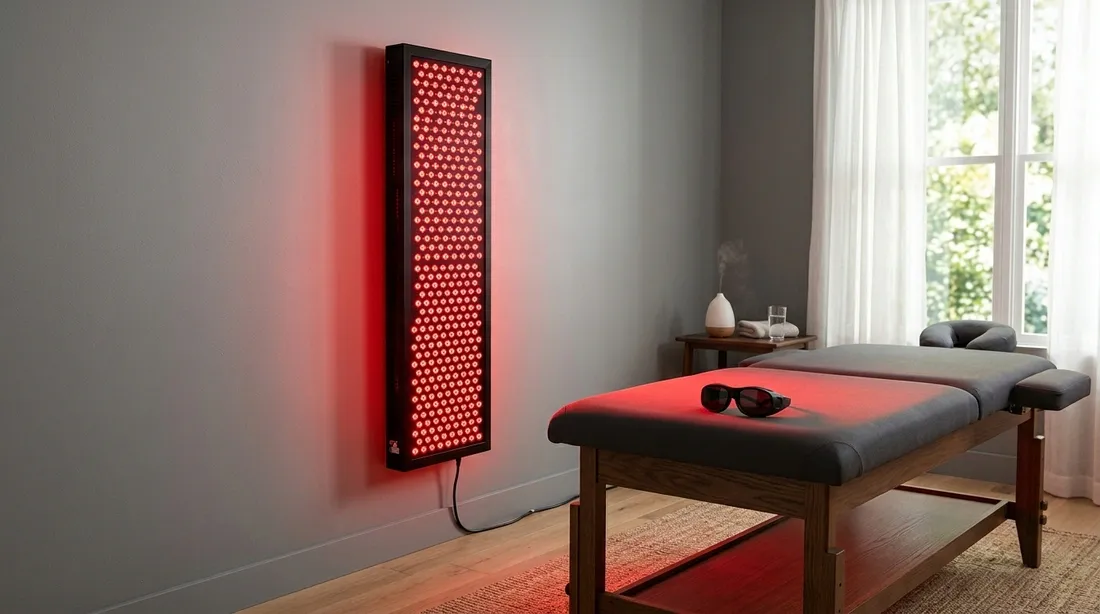
To maximize cellular recovery, select a panel emitting dual wavelengths of 660nm (red) for skin repair and 850nm (near-infrared) for deep muscle recovery. Verify the panel delivers high irradiance—at least 70 to 100 mW/cm² at 6 inches—to ensure fast, effective dosing. Insist on certified low-EMF shielding (0 mG at treatment distance) and a heavy-duty steel frame with a locking hanging pulley system.
Access our main home recovery tech guide to compare saunas, ice baths, compression, and red light therapy.
Read our detailed guidelines on inflatable ice bath walls, thermal insulation, and drain valve mechanics.
Review the best low-EMF infrared sauna blankets, non-toxic waterproof fabrics, and digital safety features.
Learn how multi-chamber compression sleeves increase circulation and relieve muscle fatigue after leg days.
1.0 Photobiomodulation Physics: How Mitochondria Absorb Light
Red light therapy is technically known as photobiomodulation (PBM). When specific wavelengths of red and near-infrared light shine on your body, they pass through your skin to reach target tissues.
Inside your cells, light photons are absorbed by cytochrome c oxidase, a key enzyme within the mitochondria. This absorption helps stimulate adenosine triphosphate (ATP) production, increasing cellular energy and supporting tissue repair and recovery.
2.0 Wavelength Engineering: Demystifying Nanometers
Not all light wavelengths provide therapeutic benefits. Studies show that red light ranging from 630 to 660 nanometers (nm) is highly effective for surface tissue, helping to support skin health and wound healing.
In contrast, invisible near-infrared (NIR) wavelengths between 810 and 850nm penetrate much deeper, reaching your muscles, joints, and tendons. Combined dual-wavelength panels deliver both red and NIR light, providing comprehensive recovery from surface skin to deep muscle tissues.
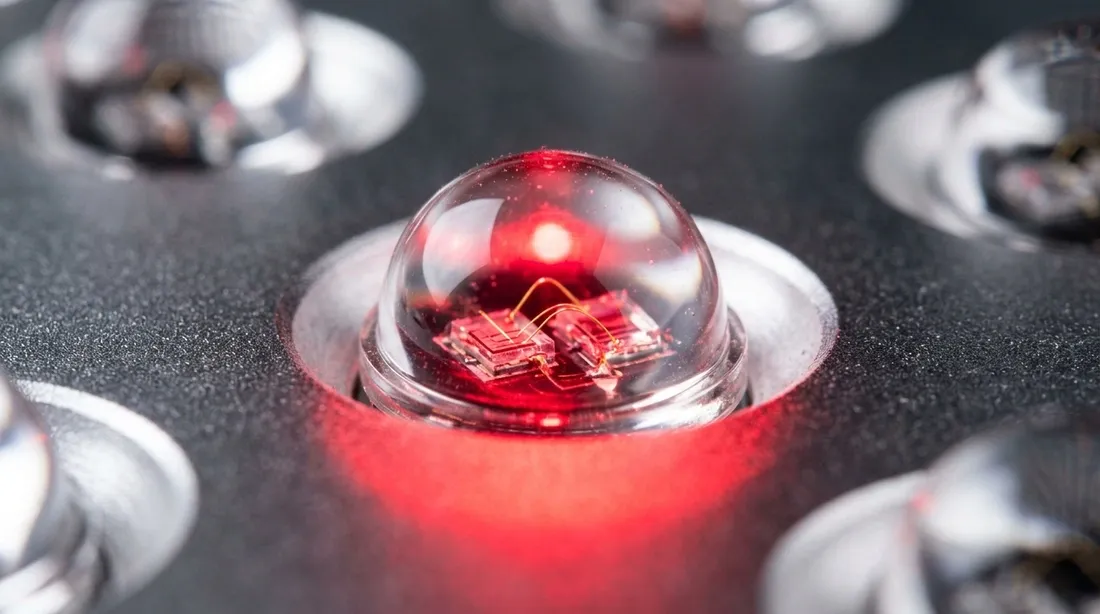
Dual-chip LED arrays project focused light beams, combining red (660nm) and invisible near-infrared (850nm) wavelengths in a single diode.
3.0 Irradiance Output: Calculating Cellular Dosage
Irradiance represents the power density of the light, measured in milliwatts per square centimeter (mW/cm²). Higher irradiance means the panel delivers more therapeutic light energy to your body.
Look for panels that deliver at least 70 to 100 mW/cm² of irradiance at a 6-inch distance. High irradiance levels ensure your cells receive a therapeutic dose of light in a short 10 to 15-minute session, rather than requiring long, time-consuming treatments.
4.0 Magnetic Suppression: Keeping EMF at Absolute Zero
Because high-output LED panels draw substantial electrical current and utilize built-in cooling fans, they can generate electromagnetic fields (EMF) close to the device.
To keep you safe during close-range sessions, choose panels built with internal shielding. Premium panels use aluminum and copper wire shielding to suppress magnetic and electrical fields, maintaining zero EMF emissions at recommended treatment distances (6 inches and beyond).
5.0 Beam Angles: 30-Degree vs. 60-Degree LED Focus
The beam angle of your panel’s LED lenses determines how widely the light disperses. Standard home panels feature either a concentrated 30-degree lens or a slightly wider 60-degree lens.
A 30-degree lens projects a highly focused beam of light, delivering deep tissue penetration but covering a smaller area. A 60-degree lens spreads the light more widely, providing a balanced coverage area and excellent penetration for larger muscle groups like your quads and back lats.

Heavy-duty hanging hardware with adjustable brass pulley toggles lets you position and lock large panels safely at multiple heights.
6.0 Cellular Muscle Repair: Scientific Reviews on Tissue Damage
Strenuous exercise creates oxidative stress and muscle fiber damage. Red and near-infrared light help stimulate mitochondrial repair, helping to accelerate your recovery between workouts.
An extensive clinical study published in PubMed Central (PMC5167494) confirms that photobiomodulation applied before or after exercise effectively reduces muscle soreness, attenuates tissue damage, and supports muscular performance recovery. This cellular support makes red light therapy highly practical for competitive athletes and lifters.
7.0 Modular Arrays and Wall-Mount Anchor Safety
While compact panels are portable, larger setups utilize multiple panels joined together with steel bracket clips to create full-body arrays.
Because these metal panels can be heavy (ranging from 6 to 20+ lbs), proper mounting is essential for safety. Always utilize heavy-duty braided steel hanging cables, anchor hooks securely over structural wooden doors, and avoid hanging heavy panel arrays from thin drywall anchors alone.
At-Home Red Light Panels Comparison
The table below outlines how different home red light panel designs compare. Swipe horizontally on mobile devices to view all technical data:
| Feature Parameter | Premium Targeted Panels (Hooga) | Full-Body Quad-Wavelength (Bestqool) | Budget Targeted Lamps / Bulbs |
|---|---|---|---|
| LED Configuration | 60 x 5W high-output LEDs | 300 dual-chip high-power LEDs | 12 to 24 low-power diode bulbs |
| Wavelength Profiles | Dual wavelengths: 660nm & 850nm | Quad wavelengths: 630/660/850/940nm | Basic red or infrared spectrum only |
| Irradiance Value (at 6″) | 73 mW/cm² | High (over 100 mW/cm² at 3″) | Low (typically under 20-30 mW/cm²) |
| EMF Shielding Profile | Zero EMF at treatment distance (6″) | Zero EMF at treatment distance (6″) | Unshielded; high magnetic emissions near body |
| Unit Weight & Mounting | 6 lbs; includes door hook and pulley | 19.1 lbs; supports wall & mobile stands | 1 to 2 lbs; clamps or standard light sockets |
Recommended At-Home Red Light Therapy Panels
Our review board has evaluated the construction quality, irradiance outputs, and mounting safety of top-performing panels on Amazon to help upgrade your recovery space.
Hooga HG300 Red Light Therapy Device
The Hooga HG300 is an exceptionally popular targeted panel that delivers medical-grade light therapy in a compact, portable format. Featuring 60 high-output 5W LEDs, it delivers a clinically proven mix of 660nm (red) and 850nm (near-infrared) light in a balanced 1:1 ratio. It features independent dual switches for custom wavelengths, a built-in stand, and a high-strength hanging pulley kit.
- Dual Therapeutic Wavelengths: Emits precise 660nm and 850nm light bands.
- High Irradiance Output: Delivers a consistent 73 mW/cm² output at a 6-inch distance.
- Certified Low EMF: Emits zero electromagnetic radiation at 6 inches.
- Very quiet cooling fan keeps the panel operating optimally.
- Includes complete hanging pulley kit, door mount, and goggles.
- Solid metal construction is highly durable and impact-resistant.
- Ideal for targeted areas (face, knee, back lats) but not full-body sessions.
- Built-in table stand cannot be adjusted vertically on its own.
Bestqool Pro300 Full Body Red Light Therapy Panel
Bestqool’s Pro300 is a large-format, high-power panel engineered to deliver professional-grade full-body therapy at home. Boasting 300 dual-chip LEDs and a highly concentrated 30-degree beam angle, this premium panel emits four advanced wavelengths (630nm, 660nm, 850nm, and 940nm) to deliver an impressive 106 mW/cm² irradiance at 3 inches. It features built-in cooling fans, modular splicing support, and an auto timer.
- 4 Advanced Light Wavelengths: Emits 630/660nm red and 850/940nm near-infrared bands.
- Exceptional 106 mW/cm² Irradiance: High power output ensures fast, deep energy penetration.
- Modular Splicing Design: Easily connect multiple panels together on a mobile stand.
- Broad coverage easily treats your entire back, chest, or legs in one session.
- Highly consistent low-EMF output keeps you safe during close-up use.
- Built-in digital control panel monitors and times your sessions.
- Sizable financial investment compared to targeted panels.
- Heavy panel (approx. 19 lbs) requires a sturdy door or mobile stand.
Frequently Asked Questions
Yes, while red light is safe for skin, high-output LED panels deliver intense brightness and high irradiance that can cause eye strain. Always wear the protective opaque goggles included with your panel, and avoid looking directly into the glowing diodes during your sessions.
For red light visible wavelengths (660nm) to be effective, they must make direct contact with bare skin. Near-infrared invisible wavelengths (850nm) can pass through light fabrics like thin cotton shirts, but direct bare-skin exposure is highly recommended to receive the full therapeutic dosage.
For consistent results, use your panel daily or 3 to 5 times a week. Position yourself between 6 and 18 inches away from the LEDs and run your sessions for 10 to 15 minutes per target area. Consistency is what separates individuals who get results from those who don’t.
