
Disclosure: As an Amazon Associate, I earn from qualifying purchases. This technical audit contains affiliate links which support our research at no cost to you.
Abstract: Pregnancy and extended sedentary office habits both lead to deep pelvic and postural decay.
Standard core training (like crunches and sit-ups) often fails to engage the deep transverse abdominis.
This technical audit evaluates the biomechanics of sandbag training for posture correction and maternal health.
We analyze pelvic tilt realignment, pelvic floor loading, and gluteal activation under shifting resistance.
1.0 Pelvic Realignment: Fixing Anterior Tilt
During pregnancy, the forward shift in body weight pulls the pelvis into an exaggerated anterior tilt.
This “Lumbar Lordosis” shortens the hip flexors and places massive, continuous compression on your lower back.
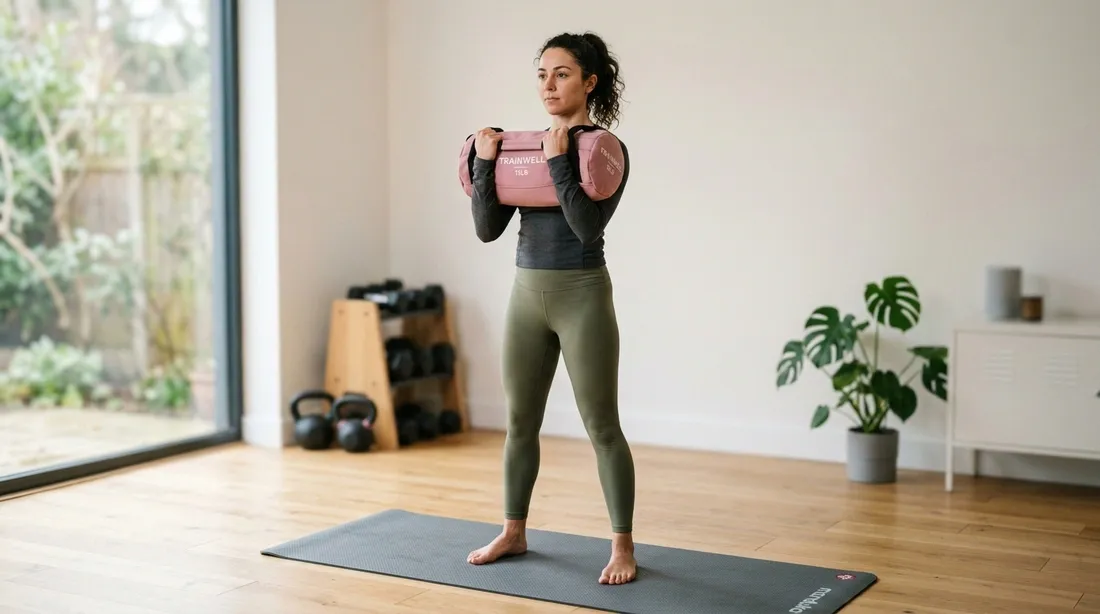
A front-loaded sandbag forces you to pull your pelvis back into a neutral alignment to balance the weight.
Clinical trials published in the National Library of Medicine show that targeted core stability exercises are highly effective at reducing postpartum back pain and improving trunk alignment.
Using a sandbag as the load provider combines core stability with functional muscle loading.
2.0 Maternal Rehabilitation: Safe Postpartum Core Loading
Postpartum recovery requires closing the abdominal separation known as Diastasis Recti.
Standard sit-ups can make this separation worse by pushing the abdominal wall outward.
Sandbags provide “Self-Limiting Loads” that can be adjusted down to low weights (10 – 20 lbs) for safety.
By holding a light sandbag in a bear hug, you activate the deep transversus abdominis safely.
This isometric hold acts as an internal corset, pulling the abdominal wall back together without dangerous flexion.
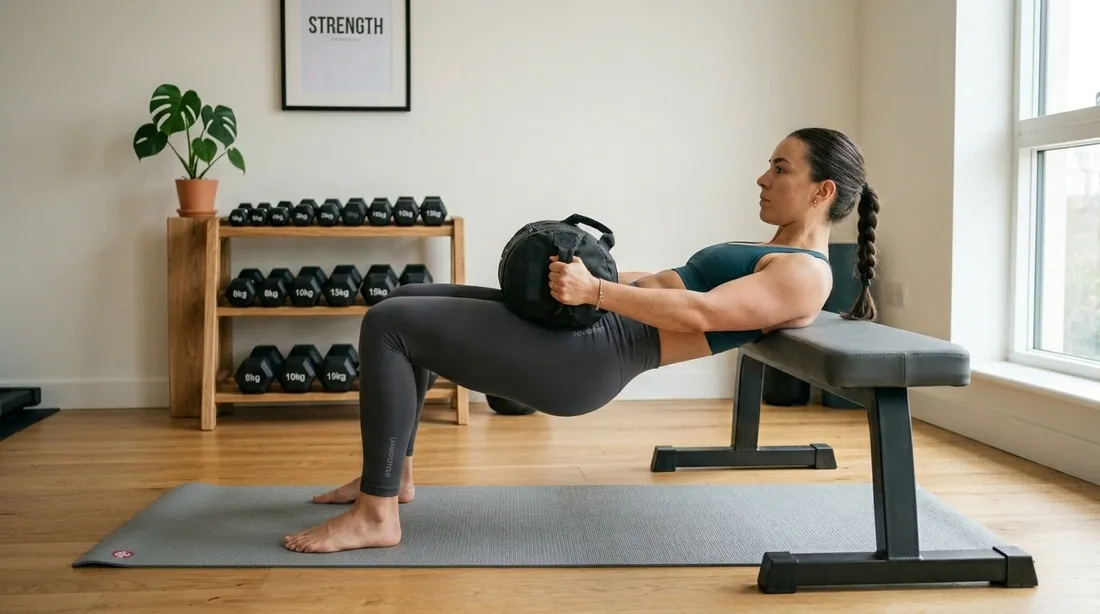
Resting a soft canvas sandbag across your pelvis is much more comfortable than a steel barbell.
Performing hip thrusts with this weight directly isolates the gluteal complex and pelvic floor.
3.0 Progressive Load Thresholds for Posture & Recovery
This comparison table is responsive. Swipe horizontally on mobile to review details:
| Recovery Level | Recommended Bag Weight | Target Core Movements | Biomechanical Objective |
|---|---|---|---|
| Level 1: Initialization | 10 – 20 lbs (Very light) | Bear hug carries, seated twists | Re-activate deep transverse abs |
| Level 2: Pelvic Balance | 20 – 35 lbs (Light-moderate) | Sandbag glute bridges, light rows | Restore pelvic floor stability |
| Level 3: Functional Power | 35 – 50 lbs (Moderate) | Front-loaded squats, deadlifts | Build total posterior chain strength |
4.0 Ergonomic Training Implements for Safe Loading
For posture work and postpartum recovery, you need an adjustable sandbag shell that can be scaled down to low weights.
REP Fitness Ballistic Sandbag
- Can be easily scaled down to 10 lbs with dynamic filler bags
- Premium 1000D Cordura shell has a soft, non-abrasive surface
- Serrated, ergonomic handles support easy carry setups
Yes4All Workout Sandbag System
- Multi-filler bags let you adjust the weight in small increments
- Highly cost-effective way to start home recovery programs
- Soft canvas material lies comfortably across your hips
5.0 Technical FAQ: Posture & Maternal Recovery
Always get clearance from your doctor first. Generally, you can begin light Level 1 breathing and pelvic floor exercises 6 weeks after a standard birth, or 8 to 12 weeks after a C-section.
No, as long as you keep the weight light and keep your core braced. The front-load actually forces your deep transverse abs to contract, which helps pull the abdominal wall back together safely.
A steel barbell compresses the pelvic bones, which can be very painful. A canvas sandbag molds to your body, distributing the weight evenly across your hips for a much safer and more comfortable exercise.
