
Disclosure: As an Amazon Associate, I earn from qualifying purchases. This technical audit contains affiliate links which support our research at no cost to you.
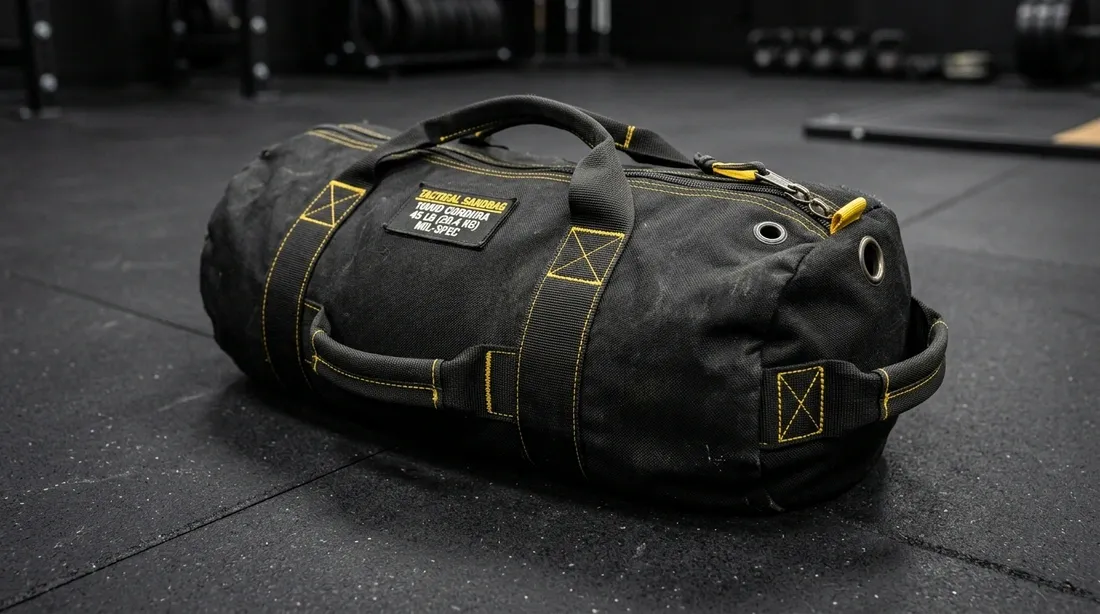
Abstract: Traditional resistance equipment relies on static, balanced mass objects.
Steel barbells and dumbbells feature a fixed, predictable center of gravity.
This technical audit evaluates “Dynamic Load Instability” using heavy-duty sandbags.
We analyze the physics of shifting mass, outer shell textiles, and total core stabilization metrics.
1.0 The Physics of Shifting Mass (“Dynamic Load Instability”)
Unlike steel, dry sand acts fluidly inside a heavy-duty fabric container.
Every repetition causes the sand to shift, changing the object’s center of gravity.
This “Functional Friction” forces the body’s stabilizer muscles to fire continuously during movement.
Clinical studies indexed in the National Library of Medicine (PMC9690442) show that unstable load training significantly increases core muscle recruitment compared to static weights.
This dynamic challenge builds real-world, functional strength that directly protects your joints from daily injury.
2.0 Technical Anatomy of a Training Sandbag
High-velocity impacts require industrial-grade materials to prevent seam failure and filler leakage.
The standard benchmark for training bags is 1000D military-grade Cordura nylon.
This fabric resists tearing, abrasions, and moisture during high-repetition dropping programs.
For comfortable lifting, choose filler bags with clean, double-sealed hook-and-loop systems.
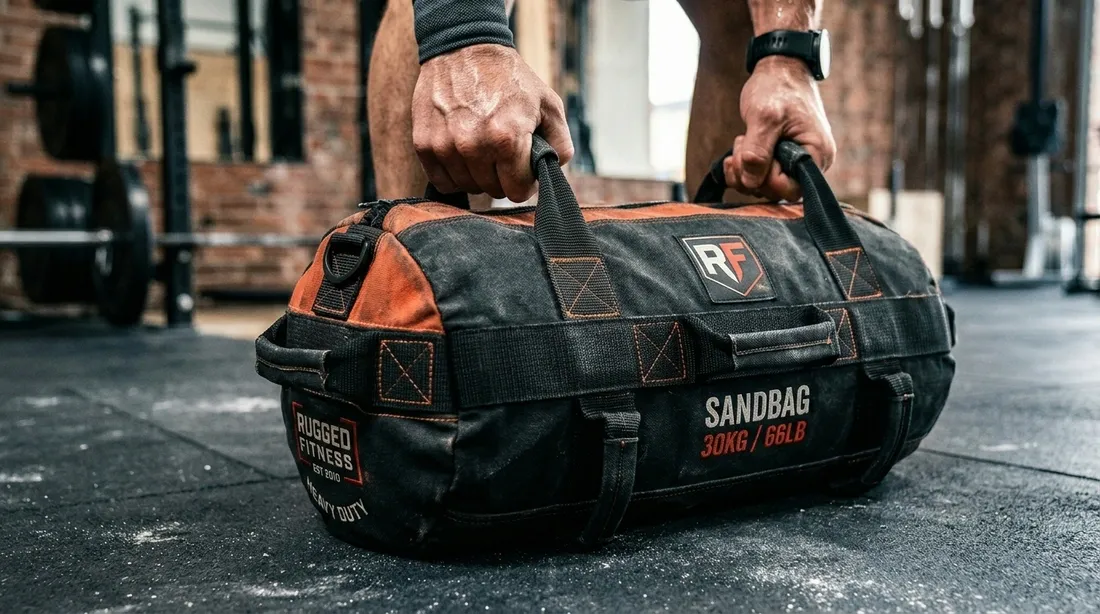
Industrial triple-stitching along the seams prevents filler material from migrating during drops.
Multiple handle positions allow for diverse clean, squat, press, and drag variations.
3.0 Equipment Audits: Leading Systems
We have benchmarked the top-performing sandbag systems on Amazon based on stitch shear resistance and handle durability.
REP Fitness Ballistic Sandbag
- 1000D Cordura construction with double-stitched seams
- Interior filler bag features a spill-proof double seal
- Provides diverse handle configurations for heavy carries
Yes4All Workout Sandbag System
- Multi-handle design for diverse grip progressions
- Highly budget-friendly entry point for home gyms
- Includes multiple interior loading filler bags
4.0 The Functional Silo: Core Training Connections
To fully utilize a sandbag home gym, you must understand how different exercises activate the kinetic chain.
We have broken this training philosophy down into four dedicated spoke directives:
Carrying and front-loading a sandbag places massive isometric demands on your posterior chain and upper back. Read our full movement audit: Sandbag Squats & Carries: Biomechanical Movement Analysis.
Learn why lifting shifting mass builds superior grip and stabilizer strength compared to static steel. Read our comparative analysis: Sandbag Training vs. Traditional Weightlifting.
Unstable loading is highly effective for building core stability in mothers and restoring alignment after desk fatigue. Read our specialized guide: Sandbag Training for Posture & Maternal Health.
Safety is vital when throwing and catching ballistic loads. Review proper injury prevention steps and real-world results. Read our recovery guide: Sandbag Training Safety and Real-World Transformations.
5.0 Technical FAQ: Sandbag Engineering
Clean, dry play sand is the technical gold standard for density. If you require a larger, lower-density bag for functional throws, recycled rubber mulch can be mixed with sand to add volume without adding excessive weight.
Biomechanically, yes. The shifting center of gravity forces your body to recruit 20% to 30% more stabilizer and core muscle fibers than a balanced dumbbell to control the same amount of weight.
Always use a high-quality outer shell with a double-zipper closure. Ensure your internal filler bags have thick, double hook-and-loop seal closures to prevent dust migration during drops.