
Disclosure: As an Amazon Associate, I earn from qualifying purchases. This technical audit contains affiliate links which support our research at no cost to you.
Abstract: Standard squatting and carrying routines are restricted by balanced, linear loading.
Using a shifting mass system changes how force is distributed across the core during dynamic movement.
This technical audit evaluates the biomechanical loading of sandbag squats and carries.
We analyze abdominal pressure, spine protection, and posterior chain activation during deep flexion.
1.0 Biomechanics of the Sandbag Front Squat
Traditional back squats place heavy, direct weight straight down on the cervical spine.
This “Axial Loading” can compress the lower back disks if your form breaks down.
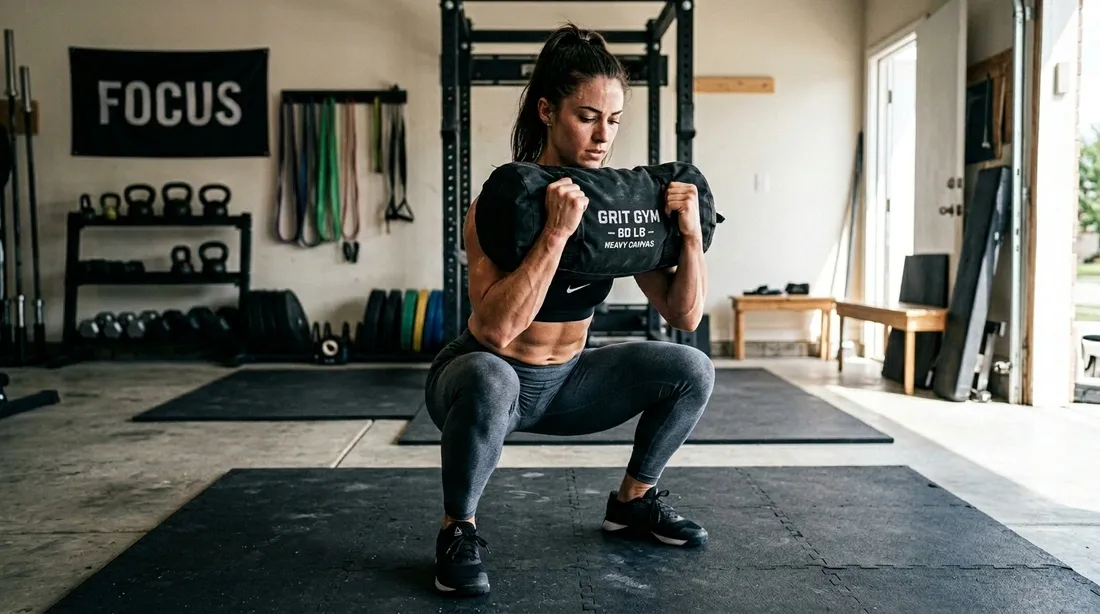
A sandbag front squat moves the weight to the front of your body, resting across your chest.
This front-loaded position forces your upper back muscles to contract hard to keep you upright.
A clinical study published in the Journal of Strength and Conditioning Research demonstrates that front-loaded squats produce significantly lower knee and lumbar compressive forces while maintaining similar muscle recruitment to back squats.
This posture keeps your spine in a safer, more vertical alignment during deep hip flexion.
2.0 The Physics of the Bear Hug Carry
Carrying a heavy load against your chest is one of the most natural human movements.
The “Bear Hug Carry” forces your core muscles to stay tense to keep your body balanced.
This continuous tension builds highly functional abdominal pressure to protect your lower back.
According to biomechanical research on carries published in PubMed Central (PMC5929471), carrying loaded implements creates massive spinal stability and high isometric trunk muscle activation.
Additionally, keeping your arms locked around the shifting bag builds great grip and upper-body endurance.
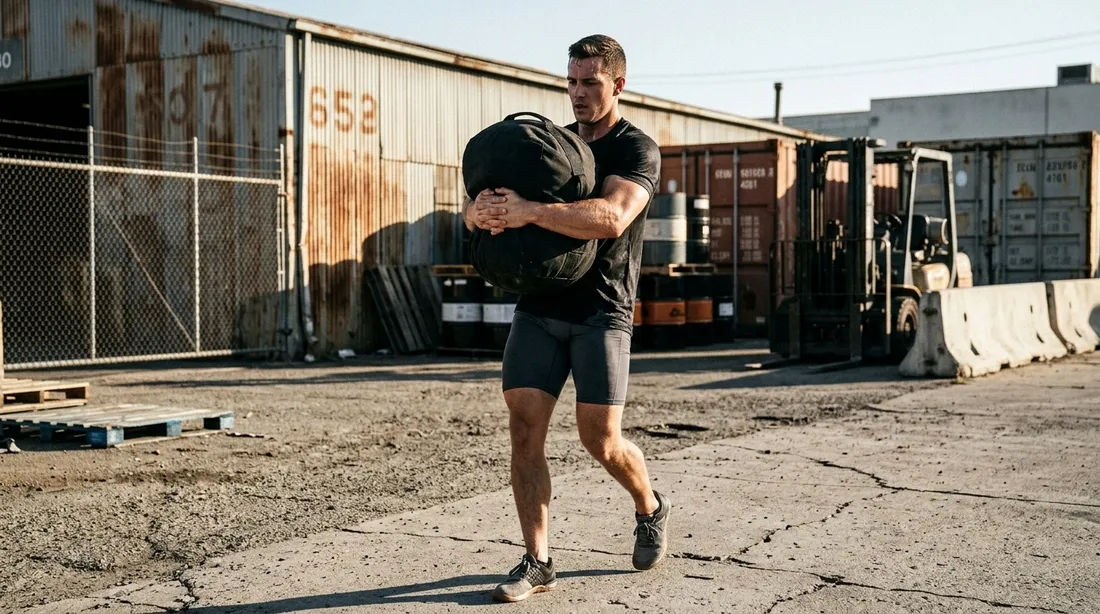
The shifting sand requires minor postural corrections with every single step you take.
This movement keeps your glutes, lower back, and deep core working together dynamically.
3.0 Comparative Biomechanical Metrics
This table compares the muscular loading of sandbag movements versus traditional barbell lifts:
| Biomechanical Vector | Traditional Barbell Squat | Front-Loaded Sandbag Squat | Active Bear Hug Carry |
|---|---|---|---|
| Spine Compression | High (Direct axial load) | Low (Anterior loading) | Low (Self-limiting load) |
| Core Activation | Moderate (Static brace) | High (Active anterior brace) | Maximum (Dynamic stabilization) |
| Grip Demand | Low (Static bar hold) | Moderate (Handle pull) | High (Constant closed-loop crush) |
| Related Guide | Home Gym Guide | Sandbag Hub | Sandbag Hub |
4.0 Recommended High-Yield Training Implements
To safely perform heavy carries and front-loaded squats, you need an outer shell designed to withstand extreme dynamic shear force.
REP Fitness Ballistic Sandbag
- 1000D Cordura nylon prevents seam-bursting during high drops
- Serrated, non-slip handle placement supports secure carry locks
- Ideal outer shell flexibility for comfortable bear-hug holds
Yes4All Workout Sandbag System
- Reinforced multi-grip system allows easy shoulder-squat setups
- Cost-effective entry point for loaded carry progressions
- Thick interior liner prevents fine dust leaks during drops
5.0 Technical FAQ: Squats & Carries
Because the weight is positioned in front of your body, your upper back muscles (rhomboids and traps) must contract constantly to keep your torso upright and prevent slouching.
Yes. Moving the weight to your chest reduces direct downward spinal pressure. This anterior placement lets you stay more upright, protecting your lower back during deep squats.
Beginners should focus on carrying the bag for short, controlled distances of 50 to 100 feet. As your grip and core strength improve, you can extend your carry distance or increase the weight.
