
You’ve chosen the perfect ball and learned how to inflate it properly.
Now, the real fun begins. It’s time to use your new tool to build a stronger, more stable body.

This guide provides ten foundational stability ball exercises perfect for beginners.
What are the best stability ball exercises for beginners?
The best stability ball exercises for beginners focus on building core strength and balance safely. A great starting routine includes the Wall Squat for leg strength with back support, the Plank for core stabilization, the Crunch for abdominal muscles, and the Bridge for glutes and back support.
They will help you build confidence, engage your core, and improve your balance safely.
Safety First – Quick Reminders Before You Start
Your safety is the top priority. Keep these points in mind before every workout:
- Clear Your Space: Make sure you have plenty of room around you, free from sharp objects or furniture.
- Warm-Up: Always start with 5 minutes of light cardio, like marching in place, to prepare your muscles. For more ideas, check out our guide on the art of the warm-up.
- Go Slow: Focus on slow, controlled movements. The goal is muscle control, not speed.
- Engage Your Core: For every exercise, consciously tighten your abdominal muscles by pulling your belly button in toward your spine.
The 10 Foundational Stability Ball Exercises
1. Stability Ball Wall Squat

- Muscles Worked: Glutes, Quads, Hamstrings, Core
- How to Do It:
- Place the ball between your lower back and a sturdy wall.
- Walk your feet out in front of you, about hip-width apart.
- Slowly lower your body into a squat, keeping your back straight. Allow the ball to roll up your spine.
- Pause when your thighs are parallel to the floor, then press through your heels to return to the start.
- Beginner Tip: Only go as low as you feel comfortable and stable. Don’t let your knees travel past your toes.
2. Stability Ball Pelvic Tilt

- Muscles Worked: Deep Core (Transverse Abdominis)
- How to Do It:
- Lie on your back with your knees bent and your calves and heels resting on the ball.
- Exhale and gently engage your abs to tilt your hips upward, pressing your lower back into the floor.
- Inhale and return to a neutral position. The movement should be small and controlled.
- Beginner Tip: This is a very subtle movement. Focus on using your lower abs, not your legs, to create the tilt.
3. Stability Ball Crunch

- Muscles Worked: Upper Abs (Rectus Abdominis)
- How to Do It:
- Sit on the ball and walk your feet forward until your lower back is supported by the ball.
- Place your hands behind your head or across your chest.
- Exhale and lift your upper body, curling your chest toward your hips.
- Inhale and slowly lower back to the starting position.
- Beginner Tip: Keep your neck relaxed. The movement should come from your abs, not from pulling on your head.
4. Stability Ball Plank

- Muscles Worked: Full Body, especially Core and Shoulders
- How to Do It:
- Kneel on the floor and place your forearms on the top of the stability ball.
- Lift your knees off the floor, extending your legs behind you to form a straight line from head to heels.
- Hold this position, keeping your core tight and your back flat.
- Beginner Tip: If this is too hard, start by holding the plank from your knees instead of your toes.
5. Stability Ball Bird-Dog

- Muscles Worked: Core, Glutes, Lower Back, Shoulders
- How to Do It:
- Lie with your stomach and hips on the ball, with your hands and toes touching the floor for support.
- Find your balance, then slowly extend your right arm straight forward and your left leg straight back.
- Hold for a moment, then slowly lower them.
- Repeat on the other side (left arm, right leg). That’s one rep.
- Beginner Tip: Focus on balance, not height. It’s better to lift your arm and leg only a few inches with control than to lift them high and wobble.
6. Stability Ball Bridge

- Muscles Worked: Glutes, Hamstrings, Core
- How to Do It:
- Lie on your back with your head and shoulders resting on the floor and your heels on top of the ball.
- Engage your core and glutes to lift your hips off the floor until your body forms a straight line.
- Hold for a moment, then slowly lower your hips back down.
- Beginner Tip: To make it easier, place the ball closer to your body. To make it harder, roll it further away.
7. Stability Ball Incline Push-Up

- Muscles Worked: Chest, Shoulders, Triceps, Core
- How to Do It:
- Place your hands on the sides of the ball, slightly wider than your shoulders.
- Walk your feet back into a plank position. The further the ball is from your feet, the harder the exercise.
- Lower your chest toward the ball, then press back up to the start.
- Beginner Tip: Start with the ball against your hips or thighs. As you get stronger, walk it down toward your shins. For more ideas on building leg strength, see our home leg workout tips.
8. Stability Ball Back Extension

- Muscles Worked: Lower Back, Glutes
- How to Do It:
- Lie with your stomach on the ball and your feet braced against a wall.
- Cross your arms over your chest.
- Slowly lift your chest off the ball until your body is in a straight line.
- Lower back down with control.
- Beginner Tip: Use your back and glute muscles to lift. Avoid using momentum or arching your back excessively.
9. Stability Ball Leg Lifts

- Muscles Worked: Lower Abs, Hip Flexors
- How to Do It:
- Lie on your back and squeeze the stability ball between your feet and ankles.
- Press your lower back into the floor and slowly raise the ball toward the ceiling until your legs are vertical.
- Slowly lower the ball back toward the floor, but don’t let it touch.
- Beginner Tip: If your back arches, only lower the ball halfway down.
10. Stability Ball Seated March

- Muscles Worked: Core, Balance
- How to Do It:
- Sit tall on the stability ball with your feet flat on the floor and your core engaged.
- Slowly lift one foot a few inches off the floor without leaning to the side.
- Lower it with control and repeat on the other side.
- Beginner Tip: This is a pure balance challenge. Keep your hands on your hips to ensure they stay level.
3 Common Beginner Mistakes to Avoid
As you learn these exercises, you’ll progress much faster by avoiding these common pitfalls.
1. Using Momentum, Not Muscle
The goal of stability training is control. Rushing through reps or using jerky movements defeats the purpose.
- The Fix: Perform every single movement—both the lift and the release—slowly and deliberately. A 3-second count for each part of the movement is a great place to start.
2. Improper Ball Inflation
An under-inflated ball feels mushy and won’t challenge your stabilizer muscles. An over-inflated ball is too rigid and can compromise your balance.
- The Fix: Before your workout, do a quick “press test.” The ball should indent about two inches when you press on it, as detailed in our inflation guide.
3. Arching or Sagging the Lower Back
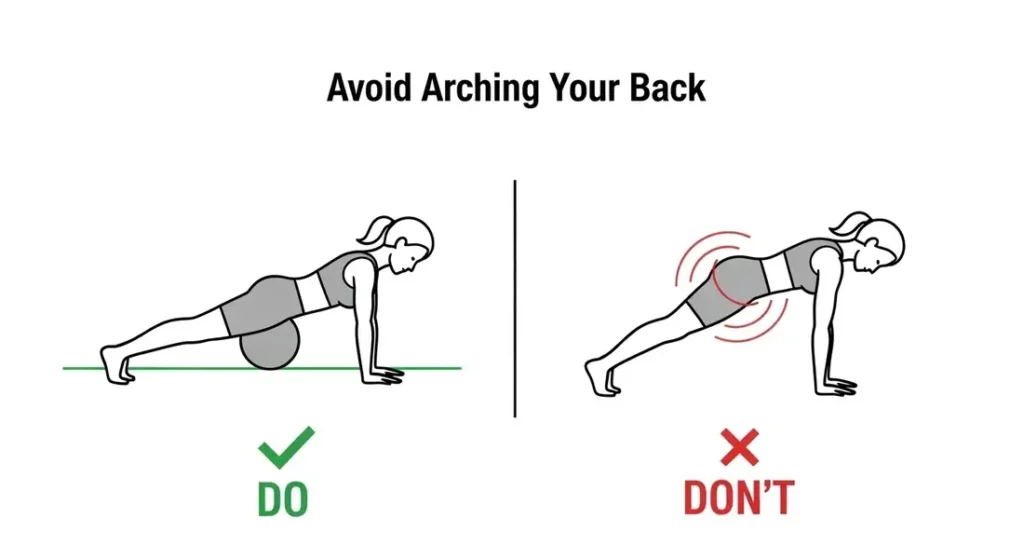
This is especially common in planks and bridges. When the core gets tired, the hips sag, which puts a dangerous strain on the lower back.
- The Fix: Always keep your core engaged by pulling your belly button toward your spine. If you feel your back starting to arch, end the set. It’s better to do fewer reps with perfect form.
Your First 15-Minute Beginner Routine
Ready to put it all together?
Try this simple circuit two to three times a week.
Perform each exercise, rest, and then repeat the whole circuit one more time.
| Exercise | Sets | Reps / Duration | Rest |
| Wall Squats | 2 | 12 reps | 30 sec |
| Pelvic Tilts | 2 | 15 reps | 30 sec |
| Seated March | 2 | 10 reps per side | 30 sec |
| Plank | 2 | Hold for 20-30 sec | 30 sec |
| Bridge | 2 | 12 reps | 30 sec |
Conclusion and Your Next Step
Mastering these ten exercises will give you a powerful foundation in strength, balance, and control.
Remember to listen to your body, focus on form over speed, and be consistent.
The stability ball is a journey, and you’ve just taken the most important steps.
Now that you know how to use your ball for a workout, have you considered how it might improve the time you spend at your desk?
Learn more in our final guide: Using a Stability Ball as a Desk Chair (Pros and Cons).