
The Final Question – Choosing the Right Tool for the Job
You’ve made it through the entire series, from understanding the benefits to mastering the essential exercises and safety rules.
You are now officially ready to begin your kettlebell journey.

But one final, practical question often remains for those building a home gym: “Should I buy kettlebells or dumbbells?”
Maybe you already own a set of dumbbells and are wondering if kettlebells are a necessary addition.
While both are phenomenal free weights, they are not interchangeable.
They are specialized tools designed for different jobs.
This guide will break down the kettlebells vs. dumbbells debate from a beginner’s perspective, helping you invest your money and time in the equipment that best aligns with your fitness goals.
Ready to make a final, informed decision?
Let’s return to our main Beginner’s Guide to Kettlebells to see how this piece fits into the puzzle.
The Core Difference – It’s All About the Center of Gravity
The fundamental difference between these two tools lies in their design, which dictates how they feel, how they move, and how your body responds to them.
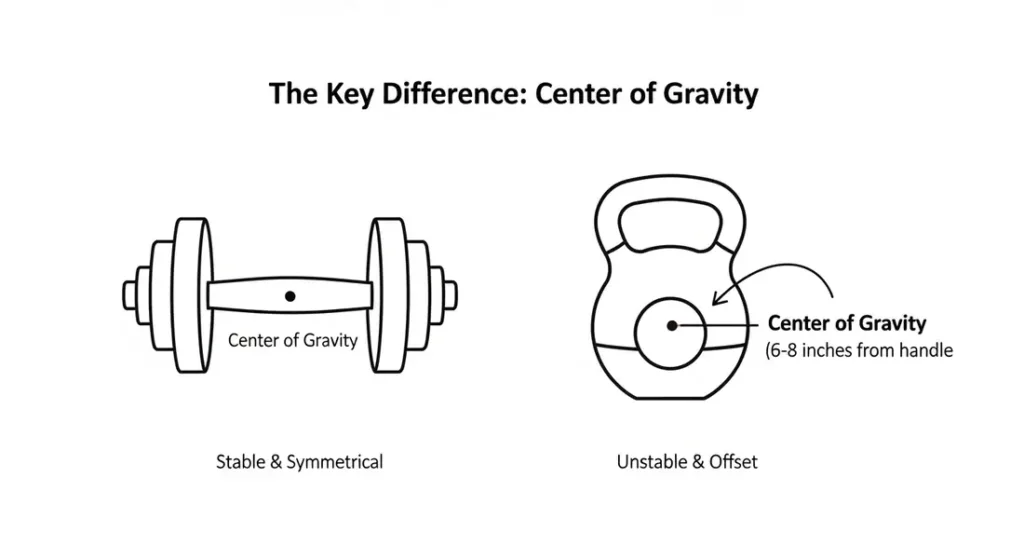
Dumbbells – The Symmetrical Tool for Isolation
A dumbbell has a perfectly balanced design. Its weight is distributed evenly on either side of the handle.
- How it feels: Stable, predictable, and easy to control.
- What it does best: This design makes dumbbells the king of isolation. They are perfect for targeting specific muscles with slow, controlled movements like bicep curls, shoulder presses, and chest flyes.
Kettlebells – The Unbalanced Tool for Integration
A kettlebell’s center of mass is offset, located about 6-8 inches below the handle.
It’s essentially a weight with a handle on top.
- How it feels: Like a dynamic, “live” weight that wants to pull away from you.
- What it does best: This unbalanced design is the kettlebell’s secret weapon. It constantly challenges your grip, core, and stabilizer muscles, forcing your body to work as an integrated unit. It excels at ballistic (fast, explosive) movements like swings and snatches that combine strength and cardio.
Kettlebells – The Unbalanced Tool for Integration
A kettlebell’s center of mass is offset, located about 6-8 inches below the handle. It’s essentially a weight with a handle on top.
- How it feels: Like a dynamic, “live” weight that wants to pull away from you.
- What it does best: This unbalanced design is the kettlebell’s secret weapon. It constantly challenges your grip, core, and stabilizer muscles, forcing your body to work as an integrated unit. It excels at ballistic (fast, explosive) movements like swings and snatches. A landmark study sponsored by the American Council on Exercise found that a kettlebell workout could burn an astounding 20.2 calories per minute—equivalent to running a 6-minute mile. This is what makes it a powerhouse for combining strength and cardio.
Kettlebells vs. Dumbbells – A Head-to-Head Comparison
| Feature | Kettlebells | Dumbbells |
| Best for Muscle Building (Hypertrophy) | Good for building functional, dense muscle. | Winner. Ideal for isolating and targeting specific muscles for maximum growth. |
| Best for Cardio & Fat Loss | Winner. Ballistic exercises like swings are unparalleled for high-intensity metabolic conditioning. | Can be used for cardio, but are less efficient and dynamic than kettlebell flows and swings. |
| Best for Functional Strength | Winner. The offset weight mimics real-life objects, building practical strength and a rock-solid core. | Good for building general strength, but in a more controlled, isolated manner. |
| Best for Absolute Beginners (Learning Curve) | Have a steeper learning curve for the most effective ballistic moves. | Winner. Basic dumbbell movements are highly intuitive and very easy to learn on day one. |
| Versatility | It’s a Tie. Excellent for a huge range of strength, cardio, and mobility exercises. | It’s a Tie. Excellent for a massive range of traditional strength and isolation exercises. |
| Space & Cost-Effectiveness | Winner. A single kettlebell provides a full-body workout, making it a highly space- and cost-effective option. | Typically require a pair, and multiple pairs for progression, making them more expensive and space-intensive. |
For a great space-saving dumbbell option, check out our review of Bowflex Adjustable Dumbbells.
Which One Should You Choose? A Goal-Oriented Guide
The best tool for you depends entirely on your primary fitness goal.
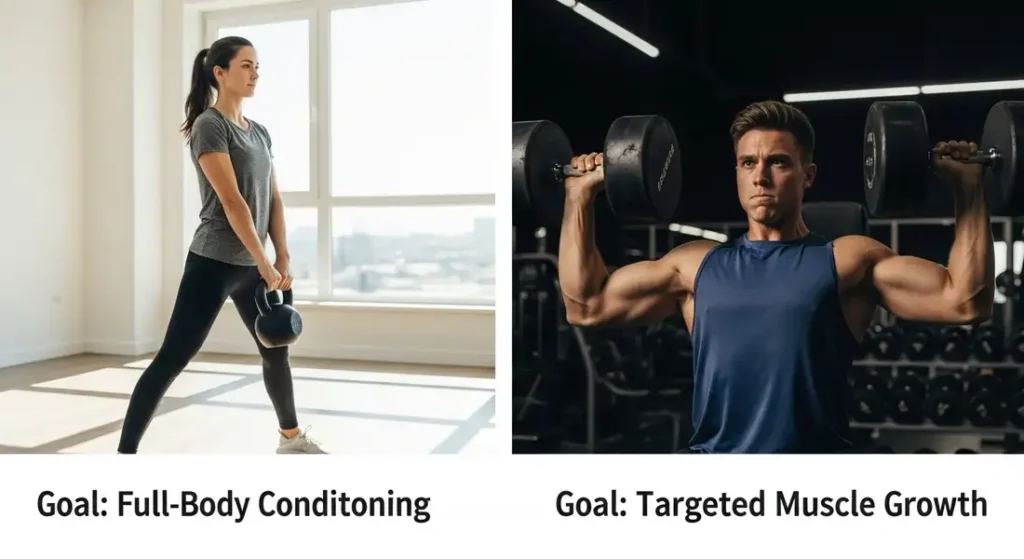
Choose Dumbbells If…
- Your main goal is traditional bodybuilding and maximizing muscle size.
- You want to follow a classic strength training program that focuses on isolating muscle groups (e.g., having a dedicated “chest day” or “arm day”).
- You are an absolute beginner who wants the easiest entry point into strength training with simple, slow, and controlled movements.
Choose Kettlebells If…
- Your main goal is to improve your overall fitness and conditioning in the most efficient way possible.
- You want to burn fat and improve your cardio while building strength at the same time.
- You want to build functional, real-world strength that helps you in sports and daily life.
- You get bored easily and enjoy learning new skills and dynamic, athletic movements.
The Pro-Level Answer – Why Not Both?
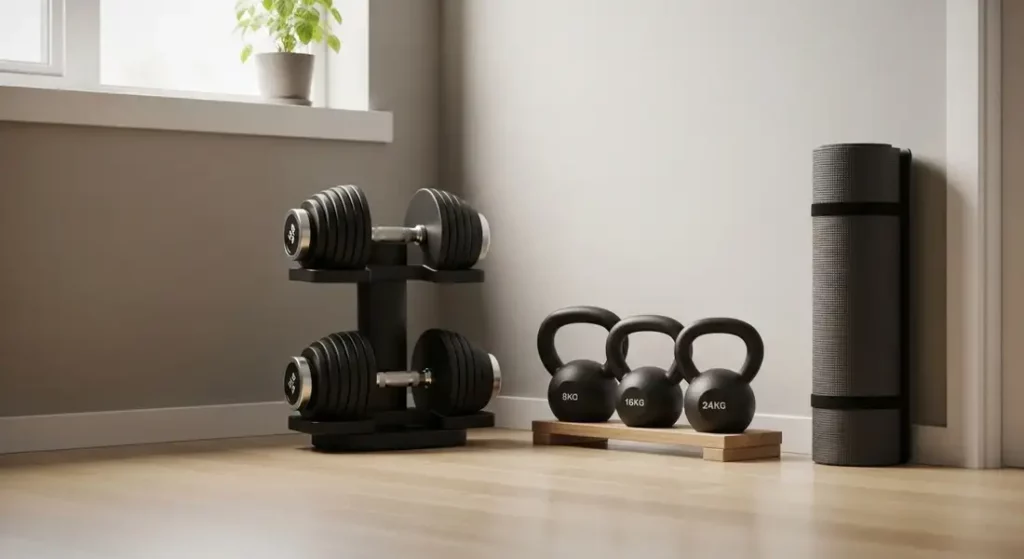
In a perfect world, a home gym would have both.
They are not enemies; they are partners.
They complement each other perfectly.
You can use dumbbells for your heavy, slow-grind days (like bench presses) and kettlebells for your high-energy, full-body conditioning days.
Frequently Asked Questions (FAQ)
Q: Can’t I just hold a dumbbell by the end and swing it?
A: This is a common but unsafe idea. A dumbbell is not designed to be swung in this way. The grip is awkward, making it much harder to hold onto, and the weight distribution is entirely different. It’s a recipe for a broken floor or a broken toe. Use the right tool for the job.
Q: I can bench press a 50 lb dumbbell. Can I swing a 50 lb kettlebell?
A: Not necessarily. The strength for different exercises doesn’t translate directly. A bench press is an upper-body push, while a kettlebell swing is a lower-body power-hinge. You will need to select your kettlebell weight based on the guidelines for kettlebell exercises, not based on what you can lift with other equipment.
Q: Which is a better investment for a small apartment?
A: Both are fantastic options. A single kettlebell (e.g., a 16 kg) takes up almost no space and offers a huge variety of workouts. A pair of adjustable dumbbells can replace an entire rack of weights and is equally space-efficient. You can’t go wrong with either.
You Have All the Answers. It’s Time to Start.
You are now fully equipped with the knowledge to build a powerful home fitness routine.
You know the what, the why, and the how.
You can confidently walk into the world of kettlebell training, or decide that dumbbells are the better starting point for your unique journey.
The most important step is the next one: the one you take.
What did you decide?
Are you Team Kettlebell, Team Dumbbell, or Team Both?
Let us know in the comments below!