
“No days off.” “The grind never stops.” “Pain is weakness leaving the body.”

Social media is full of fitness “hustle” culture, but here is the cold, scientific truth: If you don’t take rest days, you are literally throwing away your progress.
For a beginner, the hardest part of a fitness journey isn’t the workout; it’s having the discipline to stop.
This guide explains the “hidden” biology of what happens to your body on a rest day and why these 24 hours are secretly your most productive time of the week.
This is a critical component of our Ultimate Guide to Workout Recovery at Home.
💡 Why are rest days important for beginners?
Rest days are essential because they allow for Muscle Hypertrophy (growth). During a workout, you create microscopic tears in your muscle fibers. During rest, your body uses protein and hormones to repair those tears, making the muscle thicker and stronger than before. Without rest, you continue to break down tissue without allowing it to rebuild, leading to plateaus, chronic fatigue, and increased injury risk.

The 3 Pillars of Rest Day Productivity
When you take a day off, your body isn’t “doing nothing.” It is actually performing three critical physiological upgrades:
✅ The Biology of the “Off-Day”
- Muscle Protein Synthesis: This is the chemical process of repairing muscle. Research in the National Library of Medicine shows this repair peaks 24–48 hours after your workout.
- Glycogen Replenishment: Your muscles store energy called glycogen. Rest days allow your body to refill these “fuel tanks” so you have power for your next session.
- CNS Recovery: Your Central Nervous System (brain and nerves) gets “fried” by high-intensity training. Rest prevents that “heavy-limbed” burnout feeling.
Soreness vs. Progress – The Cortisol Connection

Many beginners think that if they aren’t sore, they aren’t working hard enough.
However, chronic soreness is a sign of high Cortisol (the stress hormone).
High cortisol levels tell your body to store fat and break down muscle.
By taking a rest day, you lower your cortisol, allowing your body to stay in an “Anabolic” (building) state rather than a “Catabolic” (breaking down) state.
For more on managing the physical feeling of rest, see our Active vs. Passive Recovery Guide.
Technical Tracking – How to Know You’re Recovered
As a technical specialist, I analyze how fitness sensors interpret biological data.
To truly master the science of rest, you need to look at Heart Rate Variability (HRV).
🛠️ Technical Specialist’s Note:
“Most beginners ignore the optical heart rate sensors on their wearables. To get a true ‘Readiness Score,’ I look for devices that measure HRV during deep sleep. A high HRV means your Autonomic Nervous System is balanced and ready for stress. A low HRV indicates you’re still in ‘recovery mode’ and should probably take another rest day, even if your muscles feel fine.” — IndraP
How do you know if your body is actually recovered?
Modern tech allows you to track your “Readiness Score” at home.
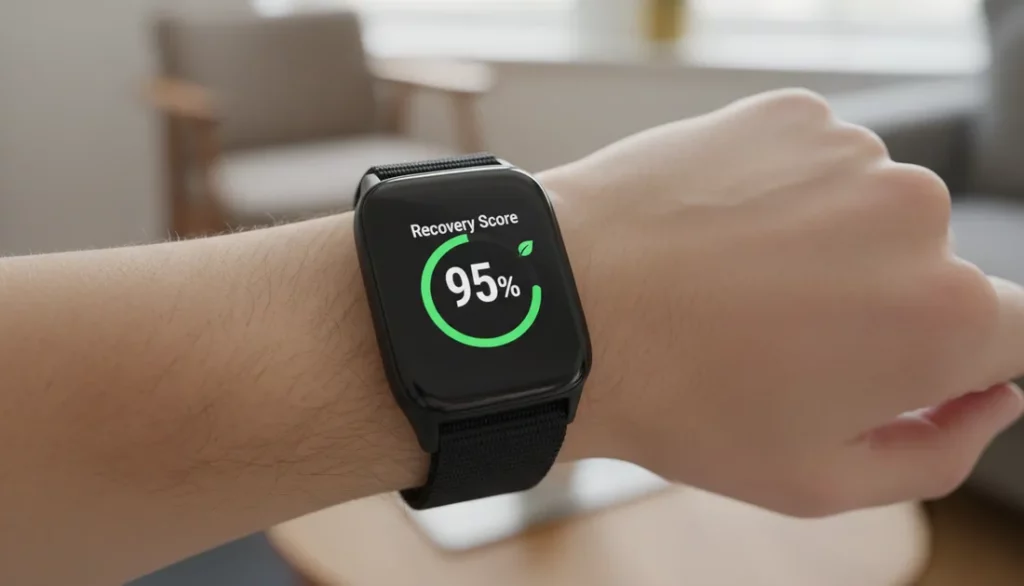
Best Tools for Recovery Tracking
🏆 Best Value – Fitbit Inspire 3
Why we picked it: It is the most affordable way for beginners to get a daily “Readiness Score.” It tracks sleep stages and HRV, helping you decide if today is a “Gym Day” or a “Rest Day.” To see where this fits in your complete home setup, check out our guide to Essential Home Fitness Gear.
5 Warning Signs You Need a Rest Day Today
If you check more than two boxes in the table below, it is a clear signal that you should prioritize recovery today over high-intensity training
| Warning Sign | How it Feels | The Technical Cause |
|---|---|---|
| Elevated Resting Heart Rate | Your morning pulse is 5-10 BPM higher than your normal average. | Your heart is working overtime to repair muscle tissue. |
| Irritability & Mood Swings | You feel “snappy,” anxious, or moody for no apparent reason. | A signal of Central Nervous System (CNS) exhaustion. |
| Workout Insomnia | You are physically exhausted but can’t fall into a deep sleep. | High Cortisol (stress hormone) levels are blocking Melatonin. |
| Localized Joint Pain | Aches in knees or elbows rather than the “meaty” part of the muscle. | Warning of potential ligament inflammation or overuse injury. |
| The “Heavy” Feeling | Your normal 20-minute workout feels like climbing Mount Everest. | Muscle glycogen (energy) stores are completely depleted. |
Frequently Asked Questions
Q: Will I lose muscle if I take two days off?
No. It takes approximately 2 to 3 weeks of total inactivity to begin losing muscle tissue. Taking 48 hours off will actually make your muscles look “fuller” as they replenish glycogen stores.
Q: Should I eat less on a rest day?
Not necessarily. Your body needs calories (especially protein) to fuel the repair process. Focus on high-quality nutrition to speed up the recovery clock.

Conclusion – Discipline Includes Resting
The most successful athletes aren’t the ones who work out the most; they are the ones who recover the best.
By respecting the science of muscle repair, you ensure that every drop of sweat you shed in your home workout actually results in a stronger version of you.
What should you do on your rest day? There are two ways to play it. You can do absolutely nothing, or you can use light movement to speed up the process.
Step 2 – Movement Strategy
Active vs. Passive Recovery Guide →
About IndraP
IndraP is the founder of Reliable Home Fitness and a Technical Equipment Specialist. Collaborating with industry leaders like FoliageField.com, he specializes in identifying top-tier training equipment.
With unique expertise in board-level repairs and upgrades, Indra looks beyond the marketing hype to test the internal mechanics of the machines he reviews. His mission is to help you invest in gear that is safe, durable, and reliable.