
Disclosure: As an Amazon Associate, I earn from qualifying purchases. This technical review contains affiliate links which support our research at no cost to you.
Transitioning your training program to a backyard space requires more than just picking the right rack; selecting the best outdoor gym flooring is critical for both joint protection and water drainage. While indoor rubber mats perform well on dry garage floors, outdoor placement exposes the sub-base to continuous rain and humidity that can quickly ruin flat, solid rubber mats.
In this technical guide, we evaluate the best outdoor gym flooring options, analyzing how under-mat drainage channels, UV stabilization, and high-traction textures prevent slip-hazards and mold. We detail the material specs you need to build a safe, rot-free outdoor training surface.
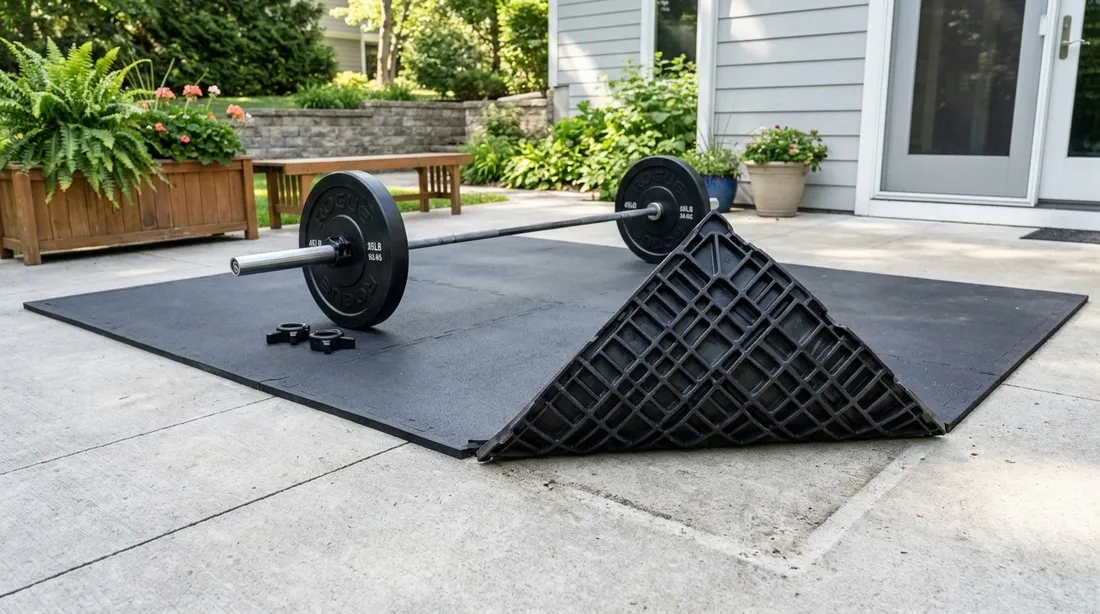
To prevent mold and slipping, avoid flat-backed indoor rubber mats. Opt for interlocking rubber tiles with underside drainage channels (waffle or grid pattern) to allow rainwater to evaporate freely. Ensure the tiles contain UV-stabilized polymers to prevent the rubber from drying out and cracking in direct sun, and choose puzzle-cut seams to lock the floor together without glue.
Access our main outdoor gym equipment setup guide to compare weatherproof power racks, weights, and covers.
Step-by-step structural tutorial on anchoring pull-up bars and racks securely into concrete, turf, or dirt.
Review the best urethane, neoprene, and rubber-coated dumbbells and kettlebells built to survive high-humidity environments.
Review the best waterproof canvas and tarpaulin covers with secure drawstring locks to protect exposed steel frames.
1.0 The Moisture Problem: Why Flat Mats Trap Water
Standard indoor rubber gym mats are completely flat on both sides. If you lay these flat mats directly onto an outdoor concrete patio or wooden deck, rainwater and overnight dew will seep into the seams.
This trapped moisture cannot escape or evaporate, creating a stagnant pool under the mat. Within weeks, this constant dampness leads to severe mold, mildew, and bacteria accumulation, which can rot wooden decks and create unpleasant odors.
2.0 Underside Waffle Channels: The Engineering of Air and Water Flow
To prevent stagnant water traps, the best outdoor gym tiles feature a molded underside. This is usually shaped in a waffle, grid, or stud pattern that raises the solid rubber body slightly off the concrete sub-base.
These hollow channels create a clear pathway for water to drain away freely toward your patio’s natural slope. They also support continuous airflow beneath the mats, allowing residual moisture to evaporate quickly after rain showers.
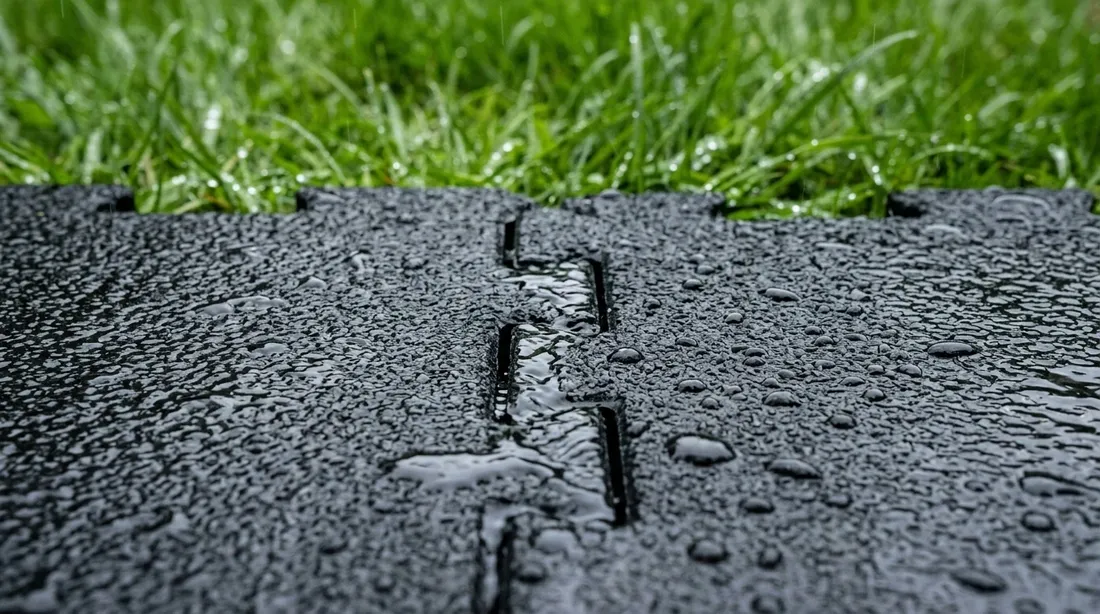
Rainwater running off slip-resistant textured rubber tiles. Water flows into the gaps rather than pooling on the surface.
3.0 UV Stabilization: Preventing Sun Bleaching and Chalky Dry Rot
Direct exposure to solar radiation is highly destructive to low-grade synthetic rubbers and plastics. Ultraviolet (UV) rays slowly break down the chemical bonds of untreated polymers.
Over time, this UV damage causes rubber mats to dry out, turn grey and chalky, and eventually crack and crumble under foot traffic. Outdoor tiles must contain UV-resistant stabilizers (like carbon black or specialty EPDM granules) to preserve their flexibility and shock absorption.
4.0 Slip Resistance: Maintaining Traction on Wet Rubber
When rubber gym tiles get wet, thin layers of water can act as a lubricant, reducing friction and causing dangerous slip hazards during explosive movements.
The best outdoor flooring features a heavily textured surface—such as a raised pebble, coin, or diamond-plate pattern. This textured profile disrupts the water surface layer, allowing your shoe soles to make direct contact with the rubber and maintain traction.
5.0 Seam Integrity: Puzzle-Cut vs. Straight Edge Tiles
When installing a gym floor outdoors, using liquid adhesives or glues is highly discouraged, as shifting ground temperatures and rain will eventually dissolve the bond.
Instead, choose interlocking puzzle-cut tiles. Precision-molded interlocking puzzle seams keep the floor locked together as a single solid unit under dynamic lateral forces, preventing individual tiles from separating or sliding.
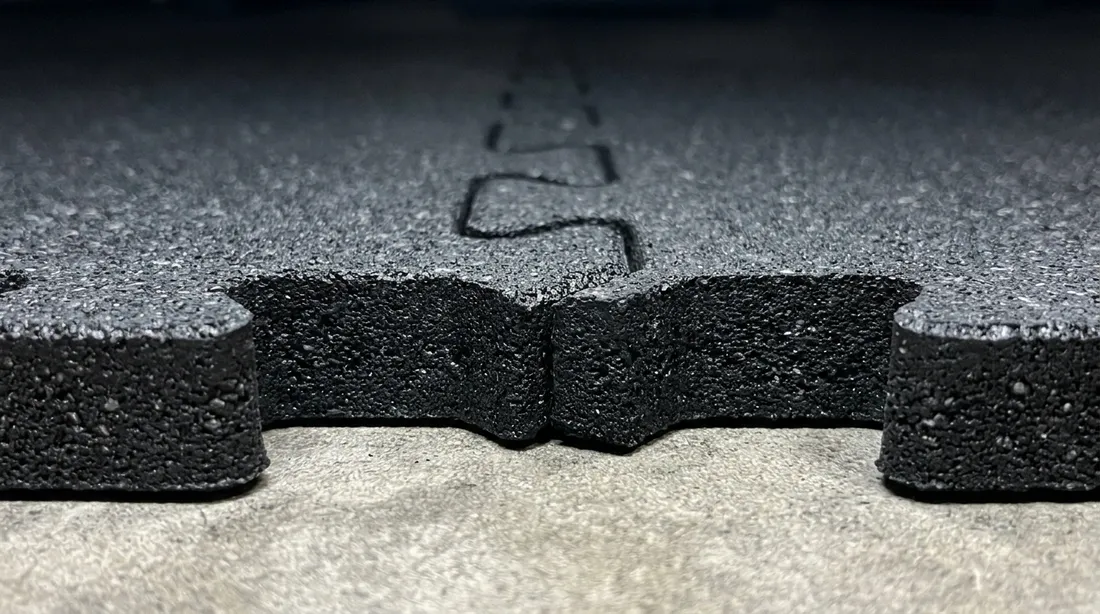
Precision puzzle-cut seams lock tiles together without messy glues, creating a stable, gap-free training surface.
6.0 Odor Profiles: Outgassing in Open-Air Environments
Recycled rubber products often emit a strong, sulfur-like odor due to the vulcanization and binding chemicals used during manufacturing. When heated by direct summer sunlight, this odor can intensify significantly.
Fortunately, open-air outdoor setups provide excellent natural ventilation. Leaving brand-new rubber mats outdoors for three to five days before installation allows this initial odor to dissipate fully.
7.0 Ground Sub-Base: Prepping Concrete, Decks, and Dirt
You can directly install high-density interlocking tiles over concrete, solid asphalt, or wooden deck surfaces. Ensure the sub-base is clean and swept free of debris before laying the tiles.
If installing over soft lawn dirt or grass, you must first dig out 2 inches of soil, lay down a weed barrier fabric, and fill the space with a compacted gravel or crushed stone base. Placing rubber mats directly over grass will trap moisture, causing the grass to rot and creating an uneven, unstable surface.
Outdoor Gym Flooring Comparison
The table below outlines how different outdoor gym flooring materials hold up to wet climates. Swipe horizontally on mobile devices to review all technical data:
| Flooring Material | Water Drainage Profile | UV Sunlight Durability | Shock Absorption Capacity | Installation Method |
|---|---|---|---|---|
| High-Density Drainage Rubber | Very High; molded waffle underside allows run-off | Very High; UV-treated crumb resists dry rot | Very High; absorbs heavy barbell drops | Interlocking puzzle seams; no glue |
| Standard Flat Rubber Mats | Poor; traps stagnant water on flat concrete | Moderate; untreated rubber can dry rot | Very High; excellent impact cushioning | Heavy straight edge sheets; prone to sliding |
| Lightweight EVA Foam Tiles | Moderate; water cannot drain underneath easily | Low; direct sun can warp and shrink foam | Moderate; too soft for heavy squat racks | Lightweight puzzle edges; easy DIY setup |
| Artificial Agility Turf | High; porous backing allows water flow | Very High; built-in UV sun resistance | Moderate; requires a rubber underlayment | Glued down or stapled to timber base |
Recommended Outdoor Gym Flooring
Our review board has evaluated the construction quality, water drainage, and slip resistance of the top-performing interlocking outdoor gym tiles available on Amazon.
Rubber-Cal “Dura-Flex” Interlocking Rubber Tiles
Rubber-Cal’s Dura-Flex tiles are specifically engineered for outdoor patio and playground setups. Constructed from durable, recycled tire rubber, these 1-inch thick tiles feature a unique waffle-patterned underside designed to allow rainwater to drain away freely, preventing stagnant pools and mold.
- Waffle-Pattern Underside: Molded channels ensure smooth water drainage.
- 1-Inch Thick Recycled Rubber: Provides excellent shock absorption for barbell drops.
- Interlocking Connector Pins: Secures the tiles together tightly without messy glues.
- Molded underside allows water to run off naturally on sloped patios.
- Highly durable, high-density rubber resists tear and puncture damage.
- Textured surface provides excellent traction even when wet.
- Requires connector pins (included in the packs) to install.
- Slightly higher cost per square foot due to thickness and drainage design.
ProsourceFit High-Density Interlocking Gym Mats
ProsourceFit’s high-density interlocking gym mats offer a highly affordable, lightweight option for backyard patios and garage training spaces. Featuring a textured, slip-resistant pebble surface and precision-cut puzzle edges, these tiles lock together securely without adhesive to provide clean joint protection.
- Textured Pebble Surface: Delivers excellent non-slip grip and traction.
- Interlocking Puzzle Edges: Simple puzzle-cut design snaps together quickly.
- Dense, Lightweight Cushioning: Provides solid support for bodyweight and kettlebell exercises.
- Highly budget-friendly option to cover large backyard spaces.
- No glue or adhesive needed; puzzle edges lock together easily.
- Lightweight tiles are easy to lift and clean underneath.
- Lacks heavy-duty drainage channels; recommended for covered patio areas.
- Too soft to support ultra-heavy power racks or heavy barbell drops.
Frequently Asked Questions
No, laying rubber mats directly over grass is not recommended. The solid mats will block sunlight and air, causing the grass to die and rot. The decomposing grass will create an uneven, spongy, and unstable surface under your feet. Always prep the area with a gravel sub-base first.
Mix a solution of one part white vinegar and three parts water in a spray bottle. Lift the affected interlocking tiles, spray the underside and the concrete slab beneath, and scrub with a stiff brush. Rinse the area with a hose and let it dry completely before re-assembling.
Yes, if you are using high-density rubber tiles that are at least 3/4-inch to 1-inch thick, they can easily absorb the impact of dropped barbells without damaging your underlying concrete slab patio. Avoid dropping weights on thin foam tiles.
