
You’re working out consistently and safely—that’s a huge achievement!
But sometimes, small, unnoticed errors can creep into your routine, limiting your results or even putting you at risk.

Think of this guide as a friendly form-check.
We’re going to highlight the five most common mistakes beginners make with resistance bands.
By identifying and fixing them, you’ll break through plateaus, get stronger faster, and build a safer, more effective workout habit.
Mistake #1 – Using the Wrong Resistance Level

This is the most common mistake and it cuts both ways.
- The Problem (Too Light): You’re using a band that provides little challenge. You can fly through your reps, and you don’t feel that satisfying muscle fatigue near the end of your set. This means your muscles aren’t being challenged enough to grow.
- The Problem (Too Heavy): You’re using a band that forces you to sacrifice form just to complete a rep. Your movements are jerky, and you can’t control the band. This not only stops you from targeting the right muscles but also significantly increases your risk of injury.
- The Fix: Revisit the “feel” test. The last 2-3 reps of a 12-15 rep set should be difficult but doable with perfect form. Don’t be afraid to use different bands for different exercises—your legs will always be stronger than your shoulders.
- Refresh your memory with our Resistance Band Level Chart.
Mistake #2 – Incorrect Form and Rushing Reps
The goal of resistance training isn’t just to move the band from point A to point B; it’s to control the tension and make your muscles work.
- The Problem: Rushing through repetitions and, most importantly, letting the band snap back on the return. This eliminates half the exercise (the eccentric, or release phase) and can be dangerous if you lose your grip.
- The Fix: Slow down! Adopt a controlled tempo. A great one to remember is “2-1-4”: Take 2 seconds to pull the band, pause for 1 second at the peak of the contraction, and take a slow 4 seconds to return to the start. This maximizes time under tension and will give you a much better workout.
Mistake #3 – Your Mini-Band Keeps Rolling Up
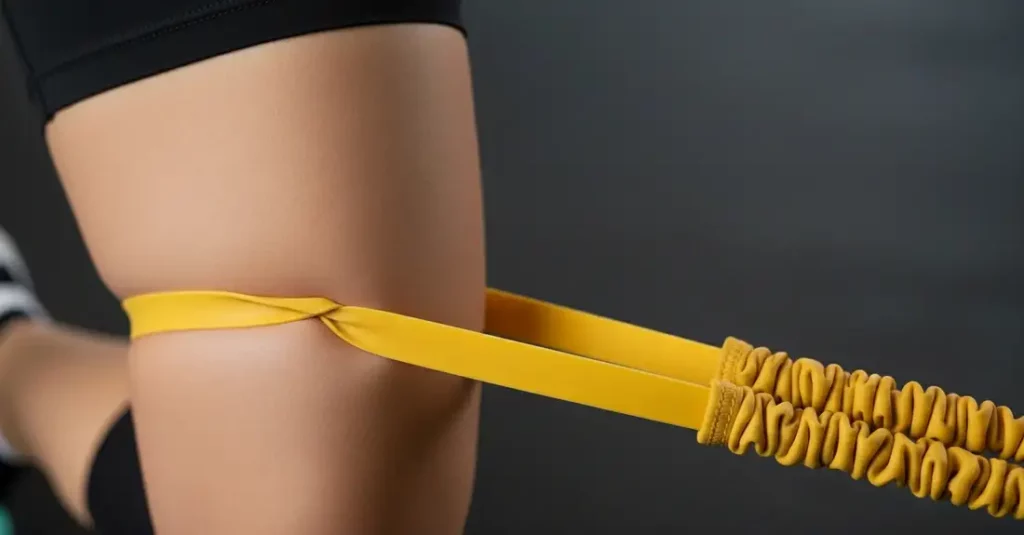
This is one of the most frustrating experiences in home fitness.
You’re in the middle of a set of glute bridges, and your latex mini-band rolls up into a thin, painful cord around your thighs.
- The Problem: This is a flaw with thin, latex-style mini-bands. When stretched, they naturally want to roll over on themselves.
- The Fix: This is an easy and worthwhile fix: switch to fabric bands. Fabric “booty” bands are wider and have non-slip rubber grips woven into the inside, which completely prevents them from rolling or sliding.
- Affiliate Link: Stop the frustration for good. We highly recommend upgrading to a set of Fit Simplify Fabric Bands on Amazon. They will transform your lower body workouts.
Mistake #4 – Incorrect or Unsafe Anchoring
We covered this in detail in our safety guide, but it’s a mistake so critical that it’s worth repeating.
- The Problem: Anchoring your band to an unstable object (like a chair leg) or using a door anchor on the wrong side of the door. This can lead to the anchor failing and the band snapping back at you.
- The Fix: Always double-check your anchor point. Is it solid? Will it move? If using a door, is it on the hinge side? Taking 10 extra seconds to ensure your anchor is secure is one of the smartest things you can do.
- For a full breakdown, review our Guide to Using Bands Safely.
Mistake #5 – Sticking to Only One or Two Exercises

It’s easy to fall into a rut and just do the exercises you know best, like bicep curls and rows.
- The Problem: Your body is not getting a balanced workout, which can lead to muscle imbalances and a boring routine. You aren’t taking advantage of the incredible versatility of your bands!
- The Fix: Make a point to try one new exercise each week. Explore movements that target different muscle groups or challenge you in a new way. Variety is key to long-term progress and keeping your workouts enjoyable.
- Get inspired and expand your routine with our 10 Essential Beginner Exercises.
Call to Action
You are now equipped with the knowledge to train like a pro—safely and effectively.
If you’re ready to enhance your workouts even further, a few simple accessories can unlock a whole new world of exercise possibilities.
Ready to upgrade?
Check out our guide to the Top Resistance Band Accessories to Maximize Your Workout.