
You’ve picked the perfect type of resistance band for your goals.
Now comes the most common question beginners ask: “What do all the colors mean, and which strength level is right for me?”

Choosing the right resistance is crucial.
Too light, and you won’t see results. Too heavy, and you’ll struggle with form, leading to frustration and potential injury.
This guide will demystify the selection process.
We’ll give you a simple chart and a practical test to ensure you can choose the perfect resistance for any exercise, allowing you to work out safely and effectively from day one.
The #1 Rule for Beginners – Always Buy a Set
Before we get into specifics, here is the most important piece of advice: buy a set of bands, not a single one.
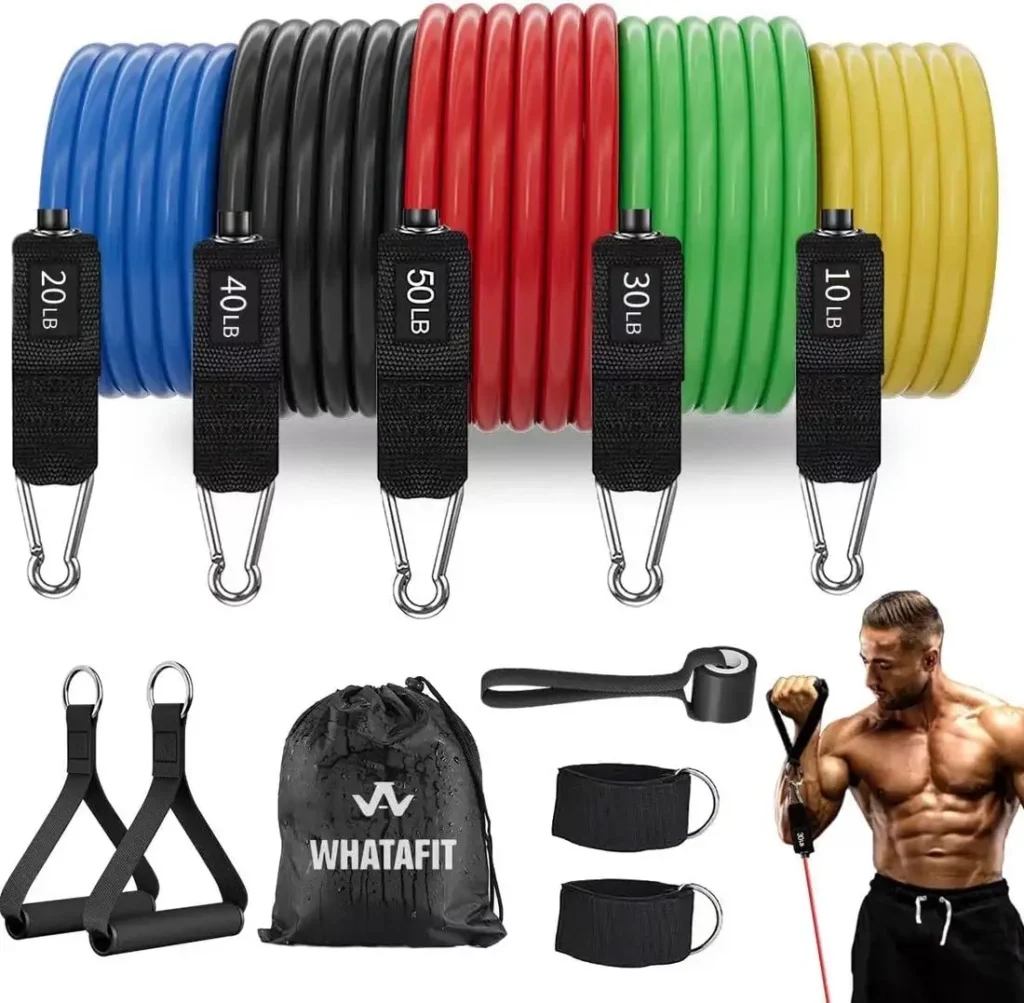
Here’s why: your body doesn’t have one uniform strength level.
The muscles in your legs and back are much stronger than the smaller muscles in your shoulders and arms.
A band that’s challenging for a squat will be impossible to use for a shoulder raise.
A set provides you with a range of options, allowing you to:
- Use the correct resistance for every exercise.
- Increase the resistance as you get stronger over time.
- Affiliate Link: This is why we recommend a versatile kit like the Whatafit Resistance Bands Set. It includes 11 pieces with a wide range of stackable resistance, giving you a perfect solution that grows with you.
A General Guide to Resistance Levels (With Chart)

While the exact colors can vary from brand to brand, they almost always follow a pattern from lighter to heavier resistance.
The chart below provides a general guideline for how to use each level.
| Resistance Level | Typical Pounds (approx.) | Best For… |
| Light | 5-15 lbs | Shoulder exercises (rotator cuff), physical therapy, warming up smaller muscle groups, exercises for seniors. |
| Medium | 20-25 lbs | Bicep curls, triceps extensions, overhead presses, and for beginners starting with lower body exercises. |
| Heavy | 30-40 lbs | Squats, lunges, chest presses, and rows for those with some strength foundation. |
| Extra-Heavy | 45+ lbs | Deadlifts, assisted pull-ups, and for strong individuals performing compound leg exercises. |
How to Know You’re Using the Right Resistance
Charts are great, but the best way to know if you have the right resistance is to listen to your body.
Here is a simple “feel” test to use for any exercise:
The perfect resistance allows you to complete 12-15 repetitions with good form, where the last 2-3 reps are challenging but still possible.
- If you can’t complete at least 10 reps: The band is too heavy. Drop down to the next level.
- If you can easily perform 20+ reps: The band is too light. It’s time to move up to the next level or combine bands.

Can You Combine Bands for More Resistance?
Absolutely! This is a key feature of most tube band sets and is known as “stacking.”
By clipping more than one band to your handles, you can create a huge variety of resistance levels.
For example, combining a 15 lb band and a 20 lb band gives you 35 lbs of resistance.
This makes your set incredibly versatile and ensures you’ll never outgrow it.
Call to Action
You’ve selected your bands and you know how to choose the right level for every movement. It’s time for the fun part! Let’s put that knowledge into action.
Ready to start moving?
Check out our guide with video tutorials: 10 Essential Resistance Band Exercises for Beginners & Seniors.