
“No pain, no gain.” It’s one of the most dangerous phrases in the fitness world.

While a certain amount of discomfort is expected when starting a home workout routine, there is a massive difference between the “productive pain” of a growing muscle and the “destructive pain” of a developing injury.
For beginners, distinguishing between the two is a vital skill for long-term health.
This guide will help you decode the signals your body is sending so you can push yourself safely without ending up on the sidelines.
This safety protocol is a mandatory part of our Ultimate Guide to Workout Recovery at Home.
In This Guide:
💡 How to tell the difference between soreness and injury?
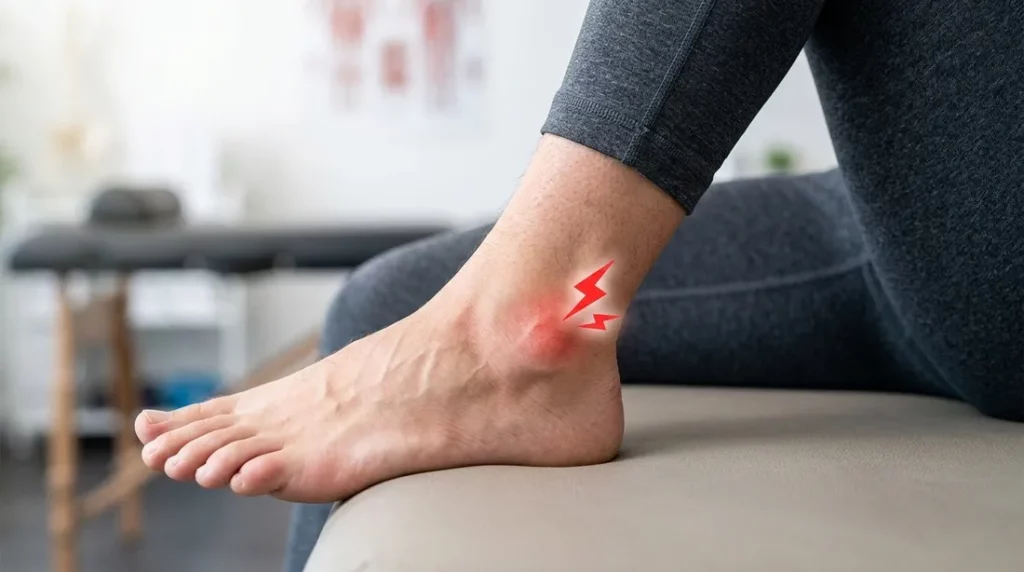
Muscle Soreness (DOMS) typically feels like a dull, aching tightness that peaks 24–48 hours after exercise and is symmetrical (felt on both sides of the body). A Workout Injury is usually sharp, stabbing, occurs suddenly during a movement, and is localized to a specific spot or joint. If pain does not improve with light movement or is accompanied by swelling and bruising, it is likely an injury and requires professional medical attention.

Soreness vs. Injury – The Quick Checklist
Before your next session, evaluate your discomfort using this comparison table.
If you’re in the “Soreness” column, you can likely proceed with Active Recovery.
| Feature | Normal Soreness (DOMS) | Possible Injury |
|---|---|---|
| Sensation | Dull ache / General tightness | Sharp / Stabbing / Throbbing |
| Timing | Starts 12–24 hours post-workout | Happens instantly during exercise |
| Symmetry | Usually both sides (e.g., both legs) | Localized to one specific spot |
| Improvement | Feels better after a light warm-up | Gets worse with any movement |
5 Warning Signs You Are Overtraining
Sometimes the danger isn’t a single event, but a gradual breakdown of your “Biological Hardware.”
Watch for these systemic red flags:
⚠️ The Overtraining Red Flags
- Morning Heart Rate Spike: If your resting HR is 5–10 BPM higher than normal, your nervous system is overtaxed.
- “Tired but Wired” Insomnia: Excessive cortisol from overtraining can prevent you from falling into deep Recovery Sleep.
- Loss of Motivation: If you suddenly dread exercises you used to enjoy, your brain is demanding a rest day.
- Chronic Fatigue: Feeling exhausted before you even start your workout.
- Persistent Soreness: Muscles that stay tender and weak for more than 4 days straight.
IndraP’s Technical Note on Duty Cycles and Component Failure
As a specialist who repairs high-end training equipment, I’ve learned that every motor has a “Duty Cycle”—a limit on how long it can run before it must be powered down to cool.
🛠️ Technical Specialist’s Note:
“When a treadmill motor is forced to run past its duty cycle without cooling, the internal windings begin to melt. Your body is much more resilient, but it follows the same laws of physics. Soreness is the heat generated during the work. If you don’t allow for a ‘cooling phase’ (recovery), you reach a point of Critical Component Failure—what we call an injury. In my shop, fixing a motor that was ignored for months is ten times more expensive than basic preventative maintenance. In fitness, one Science-Based Rest Day is cheaper and faster than six months of physical therapy.” — IndraP
What to Do if You Suspect an Injury
If your pain falls into the “Possible Injury” column, do not try to Exercise with Resistance Bands or “push through it.”
Follow the PEACE & LOVE protocol:
- PEACE (The Immediate Phase): Protect the area, Elevate it, Avoid anti-inflammatories (if possible, as they can slow initial healing), Compress with a wrap, and Educate yourself on the cause.
- LOVE (The Repair Phase): Load the muscle gradually (under professional guidance), Optimism (mental recovery matters), Vascularization (light movement to increase blood flow), and Exercise.
- Consult a Professional: If the pain persists for more than 72 hours, or if you cannot bear weight on a limb, see a doctor or physical therapist.
Frequently Asked Questions
Q: Should I take Ibuprofen for soreness?
Try to avoid it if possible. Inflammation is actually the physiological signal that tells your body to grow muscle. By “killing” the inflammation with pills, you may actually slow your progress. Use Ice vs. Heat or light movement instead.
Q: Can I work out if I’m still a little sore?
Yes, provided the soreness is mild and improves during your warm-up. However, if the soreness makes you change your form (e.g., limping while squatting), stop immediately. Poor form leads to real injury.
Conclusion – Longevity Over Intensity
The goal of home fitness is to get healthier, not to see how much pain you can tolerate.
Listen to your body’s warning signs.
Taking a single rest day early can save you from a month of forced rest later.
The final piece of the recovery puzzle? It’s the most overlooked nutrient in all of fitness. If you are dehydrated, even the best rest and stretching won’t save your muscles from fatigue.
The Final Pillar – Deep Hydration
Hydration and Electrolyte Secrets →
About IndraP
IndraP is the founder of Reliable Home Fitness and a Technical Equipment Specialist. Collaborating with industry leaders like FoliageField.com, he specializes in identifying top-tier training equipment.
With unique expertise in board-level repairs and upgrades, Indra looks beyond the marketing hype to test the internal mechanics of the machines he reviews. His mission is to help you invest in gear that is safe, durable, and reliable.