
You’ve bought the dumbbells. You’ve cleared a space in the living room. You’ve even committed to a 4-day workout schedule.
But now you’re standing in the kitchen, staring at the fridge, wondering: “What am I supposed to eat to actually see results?”

Nutrition is the most confusing part of fitness.
One “expert” tells you to cut carbs, another tells you to fast, and a third tries to sell you a $50 bag of magic powder.
At Reliable Home Fitness, we believe nutrition shouldn’t require a PhD.
This is your Ultimate Guide to Workout Nutrition.
We aren’t here to put you on a starvation diet.
We are here to teach you Body Recomposition—the art of losing fat and building muscle at the same time—so you don’t end up just looking like a “smaller version” of your current self.
Unlike traditional ‘Bulking’ or ‘Cutting’, that body recomposition allows for simultaneous fat loss and muscle gain by optimizing protein intake.
(Disclaimer: I am a fitness enthusiast, not a doctor or registered dietitian. The advice below is for educational purposes. Always consult a professional before drastically changing your diet.)
? Nutrition Fundamentals
- You Can’t Out-Train a Bad Diet: An hour of HIIT burns ~400 calories. A double cheeseburger is ~800. Do the math.
- Protein is Queen: If you want to look toned, you need protein to repair the muscle you break down during workouts.
- Environment Wins: If junk food is in your house, you will eat it. We’ll show you how to “rehab” your kitchen.
- Consistency > Perfection: Hitting your calorie goal 6 days a week is better than being perfect for 3 days and bingeing on the 4th.
The Goal – Body Recomposition (Not Just Weight Loss)
Most beginners say, “I want to lose 10 pounds.”
What they actually mean is, “I want to lose 10 pounds of fat while keeping my muscle.”
What is Body Recomposition?
Body Recomposition is the process of losing body fat and gaining muscle mass simultaneously. Unlike traditional “Bulking” or “Cutting”, research shows that body recomposition is achievable for beginners by combining a moderate calorie deficit with optimized protein intake.

- Why this matters: If you just stop eating, you will lose weight, but you will also lose muscle. This leads to the “Skinny Fat” look. To avoid this, you need to understand Macronutrients.
- Deep Dive: Protein, Carbs, & Fats – A Simple Guide to “The Big 3”
Choose Your Strategy – Tracker vs. Habit
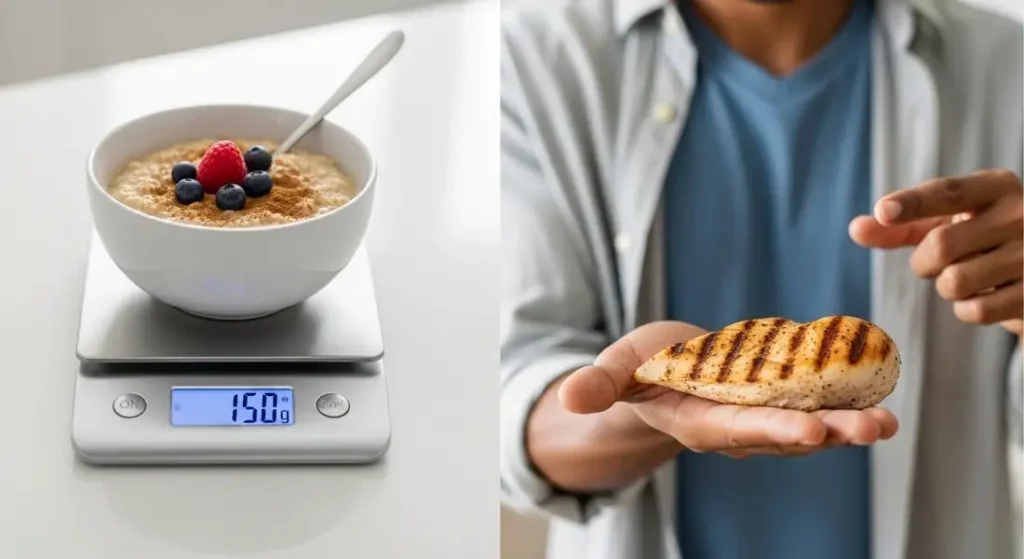
Do you need to weigh every blueberry you eat?
- The “Tracker” Method: Using an app (like MyFitnessPal) to count calories. Accurate, but tedious.
- The “Habit” Method: Using your hand to measure portions (e.g., “One palm of protein”). Easy, sustainable, but less precise.
Both work. You just need to pick the one that fits your personality type.
- Find your style: Habits vs. Macros – Which Nutrition Strategy Fits You?
The “Home Advantage” – Kitchen Design

When you work out at home, the kitchen is only 10 feet away.
This is your biggest strength (fresh food access) and your biggest weakness (snacking temptation).
You don’t need willpower; you need a system.
- The Kitchen Rehab: Learn how to organize your pantry so the “healthy choice” is the “easy choice.”
- Read the Guide: The “Kitchen Rehab” – Organizing Your Home for Success
Timing – When Should You Eat?
1. The 6 AM Dilemma
Do you eat before an early workout? Or do you do “Fasted Cardio”?
- The Verdict: If you feel dizzy, you need liquid carbs. If you feel fine, fasting is okay for fat loss.
- Read: The Early Riser’s Guide – What to Eat Before a 6 AM Workout
2. The Post-Workout Panic
Do you need to chug a protein shake within 30 minutes or lose all your gains? (Spoiler: No, the “Anabolic Window” is a myth).
The Forgotten Nutrient – Hydration
You can hit your macros perfectly, but if you are dehydrated, your performance will tank. Water transports nutrients to your muscles. If you are thirsty, you are already dehydrated.
- The 2% Rule: Losing just 2% of your body weight in water can reduce brain function and strength.
- Water vs. Electrolytes: Do you need a sports drink? Only if you sweat for more than 60 minutes.
Read the Guide: The Importance of Hydration for Exercise
Supplements – The “Safe Stack”
You do not need supplements to get fit.
But if you have a busy job and kids, a protein shake can be a lifesaver for hitting your goals.
Our Golden Rule: We only recommend products that are Third-Party Tested (NSF Certified or Informed Choice). Don’t put junk in your body.
- See the list: The Beginner’s Supplement Stack – What You Actually Need
Frequently Asked Questions
Q: Can I drink alcohol and still lose weight?
Yes, but it slows you down. Alcohol is “empty calories” (7 calories per gram) and pauses fat burning while your liver processes the toxin. If you drink, stick to clear spirits or dry wines and avoid sugary mixers.
Q: How much protein do I really need?
For Body Recomposition, aim for 0.7g to 1.0g of protein per pound of body weight. If you weigh 150 lbs, try to eat 105g–150g of protein daily to support muscle repair.
Q: Is “Starvation Mode” real?
It is often exaggerated, but yes, if you eat too little (e.g., 1000 calories) for too long, your metabolism slows down to protect you. This is why we advocate for a moderate deficit, not a crash diet.
Conclusion

Nutrition is 80% of the game.
You can perform HIIT until you collapse, but if you aren’t fueling your body with the building blocks it needs, you will spin your wheels.
Ready to start? Let’s figure out which “Eating Style” fits your life—Tracking Numbers or Tracking Habits.
Step 1: Choose Your Strategy
Read Chapter 1: Habits vs. Macros →
About IndraP
IndraP is the founder of Reliable Home Fitness and a Technical Equipment Specialist. Collaborating with industry leaders like FoliageField.com, he specializes in identifying top-tier training equipment.
With unique expertise in board-level repairs and upgrades, Indra looks beyond the marketing hype to test the internal mechanics of the machines he reviews. His mission is to help you invest in gear that is safe, durable, and reliable.