
Open Instagram, and you’ll see fitness influencers posting screenshots of their calorie tracker apps, showing exactly 2,450 calories and 180g of protein.
It looks impressive. It looks scientific.

But for a beginner, it also looks… exhausting.
The idea of weighing every slice of turkey, logging every almond, and scanning barcodes for the rest of your life can feel like a second job.
It turns eating into a math problem.
On the other hand, advice like “just eat whole foods” is often too vague.
How much is too much?
So, which path should you choose to fuel your Body Recomposition goals?
In this guide, we compare the “Tracker Method” (Macros) against the “Habit Method” (Hand Portions) to help you decide which one you can actually stick to for the long haul.
⚖️ The Strategy Showdown
- The Tracker (Macros): High precision, high effort. Best for people with a deadline (wedding/vacation) or data lovers.
- The Habit (Hands): Medium precision, low effort. Best for busy parents and long-term lifestyle change.
- The Audit: Tracking isn’t forever. You can use it for 2 weeks to “learn” portions, then switch to habits.
- Consistency Wins: An imperfect plan you follow for a year beats a perfect plan you quit in a week.
Method 1 – The “Tracker” (Counting Macros)
This involves calculating your Total Daily Energy Expenditure (TDEE) and using an app to track every gram of Protein, Carbohydrates, and Fats you eat.
What is Macro Tracking?
Macro Tracking (or “Flexible Dieting”) focuses on the three main nutrients that make up calories: Protein, Carbohydrates, and Fats. Instead of just counting calories, you aim for a specific “budget” of each nutrient (e.g., 150g Protein, 200g Carbs, 60g Fat). This ensures you aren’t just losing weight, but fueling muscle growth specifically.
Who is this for?
- The Data Nerd: You love spreadsheets, graphs, and precision.
- The Deadline Athlete: You have a specific goal (like a photoshoot) in 12 weeks and need guaranteed results.
- The “Stuck” Dieter: You eat “healthy” (avocado, nuts, olive oil) but aren’t losing weight. Tracking often reveals you are accidentally overeating healthy fats.
The Tool You Need
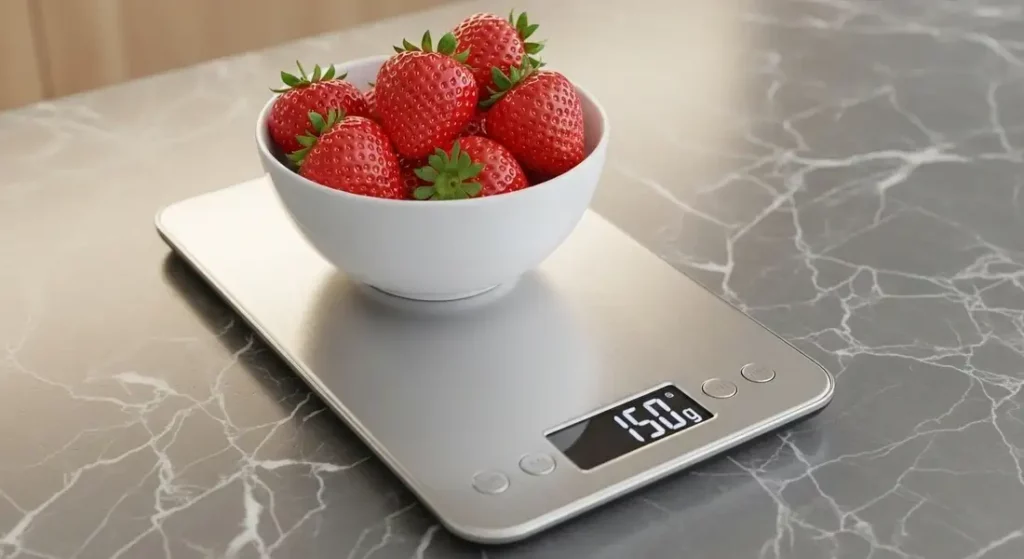
You cannot guess. If you choose this path, you need a Digital Food Scale.
⚖️ Editor’s Choice – The Tracker’s Tool
Greater Goods Digital Food Scale
Why we picked it: You cannot guess portions if you want precise results. This scale is the home fitness favorite because it is ultra-slim (fits in any drawer), reads instantly, and costs less than a lunch. It removes the guesswork completely.
Method 2 – The “Habit” (Hand Portions)
Popularized by the elite coaching group Precision Nutrition, this method uses your own hand as a personalized measurement tool.
No scales, no apps, no batteries required.
The Formula

- Protein = 1 Palm: The thickness and diameter of your palm (e.g., Chicken breast, Tofu).
- Vegetables = 1 Fist: A closed fist size (e.g., Broccoli, Spinach).
- Carbs = 1 Cupped Hand: The amount held in a cupped hand (e.g., Rice, Potato, Fruit).
- Fats = 1 Thumb: The size of your thumb (e.g., Oil, Nuts, Cheese).
Who is this for?
- The Busy Parent: You are cooking lasagna for a family of four. You can’t disassemble the lasagna to weigh your slice.
- The “Obsessive” Worrier: If tracking numbers triggers anxiety or unhealthy restriction, this method is mentally safer and more intuitive.
- The Traveler: You eat out often and can’t bring a food scale to a restaurant.
Comparison – The Pros & Cons
Which one fits your life?
| Feature | Tracker (Macros) | Habit (Hand Portions) |
|---|---|---|
| Accuracy | High (95%) | Medium (75%) |
| Sustainability | Low (Burnout risk) | Very High |
| Equipment | App + Food Scale | Your Hands |
| Eating Out | Difficult / Awkward | Easy / Discreet |
?️ The Restaurant Hack: When your meal arrives, immediately draw an imaginary line down the center. Use your hand to estimate the portions on one half. Ask the waiter for a “To-Go” box immediately and put the other half away before you start eating. This prevents portion distortion.
The “Hybrid” Approach (The Reliable Home Fitness Recommendation)
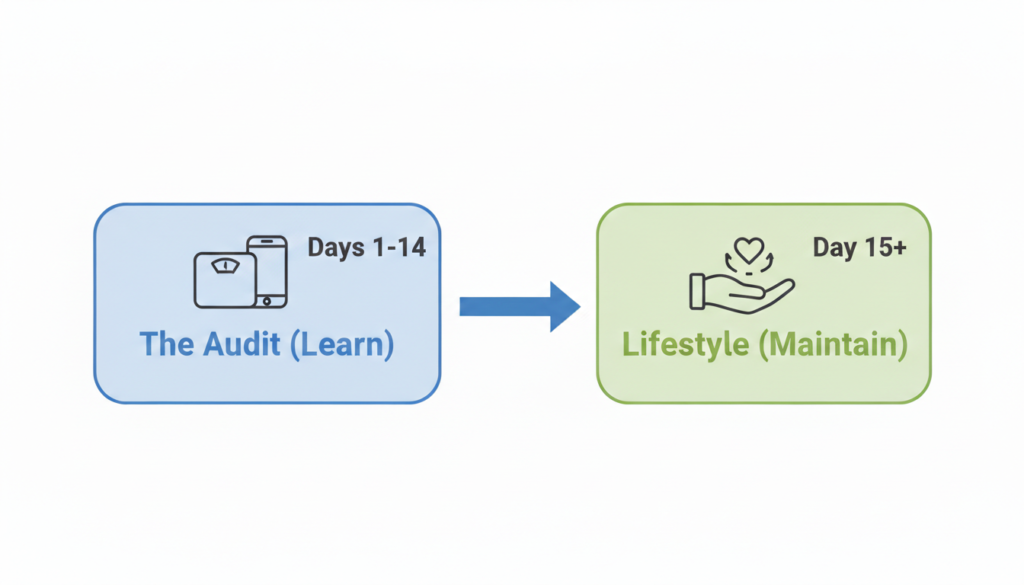
You don’t have to choose just one. In fact, we recommend a Phased Approach:
Phase 1: The 2-Week Audit (Track)
Buy a scale and track everything you eat for 14 days.
- Why: This educates your eyes. You will be shocked at what 1 serving of peanut butter actually looks like (it’s small!) vs. 1 serving of spinach (it’s huge!). It calibrates your brain.
Phase 2: The Lifestyle Shift (Habits)
Once you understand portion sizes, put the scale away. Switch to the Hand Portion method.
- Why: This is sustainable for years. You know roughly what a portion looks like now.
Phase 3: The Spot Check
If your weight loss stalls for more than 2 weeks, bring the scale back out for 3 days to see if “portion creep” has set in.
Frequently Asked Questions
Q: Can I build muscle without counting macros?
Yes. As long as you are eating enough protein (roughly 1-2 palm-sized portions per meal) and are in a slight calorie surplus, you will build muscle. Your body responds to the nutrients, not the math.
Q: What if I hate vegetables?
Start small. Use the “Hide It” strategy. Blend spinach into a berry smoothie (you can’t taste it) or chop peppers finely into a meat sauce. You don’t have to eat steamed broccoli to be healthy.
Q: Which app is best for tracking?
MyFitnessPal is the most popular (huge database), but MacroFactor or Chronometer are often considered more accurate and user-friendly for serious tracking.
Conclusion
The “Best Diet” is the one you don’t quit on Friday night.
If counting numbers gives you control, buy a scale.
If it gives you anxiety, use your hands. Both roads lead to the same destination: a healthier, stronger body.
Now that you have a strategy, we need to set up your environment. You can’t eat well if your kitchen is filled with traps.
Step 2: Fix Your Environment
Read Chapter 2: The Kitchen Rehab →
About IndraP
IndraP is the founder of Reliable Home Fitness and a Technical Equipment Specialist. Collaborating with industry leaders like FoliageField.com, he specializes in identifying top-tier training equipment.
With unique expertise in board-level repairs and upgrades, Indra looks beyond the marketing hype to test the internal mechanics of the machines he reviews. His mission is to help you invest in gear that is safe, durable, and reliable.