
In technical maintenance, you don’t just “hope” a part is repaired—you run a diagnostic test to verify its integrity.
Fitness recovery should be handled with the same precision.
Most home athletes use tools like massage guns and compression boots because they “feel good,” but they have no way of knowing if these tools are actually accelerating the healing process.
By using modern bio-sensors, you can move from “guessing” to “quantifying” your muscle repair.
This guide is the final technical layer of our Modern Fitness Progress Tracking System.
In This Guide:
💡 How can I tell if my muscles are recovered?
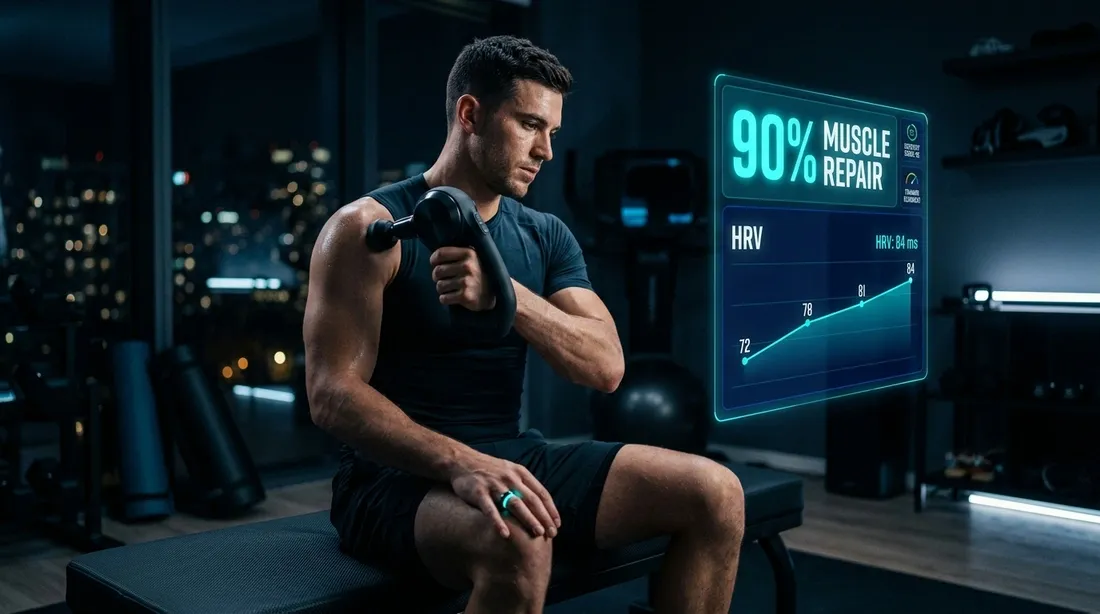
You can quantify muscle healing by tracking three specific biometric signals: Heart Rate Variability (HRV), Resting Heart Rate (RHR), and Oxygen Saturation. A fully recovered muscle system will show a return to your HRV baseline and a stabilization of RHR. Modern tools like the Theragun PRO Plus now include built-in heart rate sensors to show you exactly how your nervous system is responding to treatment in real-time, allowing you to “see” your body move from a stressed state to a repaired state.
Biometric Percussive Therapy – Tracking Relaxation
🔄 Closed-Loop Recovery – Data-Driven Healing
In 2026, we have moved beyond ‘static’ recovery routines. We now use Closed-Loop Systems where your recovery hardware adapts to your specific ‘Biological Hardware’ state.
- AI-Prescribed Routines: Premium apps from industry leaders like Therabody and Hyperice now ingest data from your Garmin or Apple Watch. If your ‘Strain’ was high today, the app automatically increases the duration and intensity of your percussive therapy.
- Real-Time Down-Regulation: By watching your heart rate drop on your Readiness Dashboard while you use compression boots, you get immediate technical confirmation that your nervous system is shifting into ‘Repair Mode.’
IndraP’s Advice: Recovery is a ‘Biological Duty Cycle.’ If you don’t track the impact of your tools, you are just vibrating your muscles without a diagnostic goal.

Traditional massage guns are “blind” tools. You turn them on and hope for the best.
Modern recovery tech, however, uses Smart Muscle Recovery Tools to provide feedback.
For the 40+ professional, recovery is often about down-regulating the nervous system after a stressful day.
By watching your heart rate drop on your device’s screen as you use percussive therapy, you are getting technical proof that your “Recovery Hardware” is working.
✅ How to Quantify Your Recovery Tools
- The HRV Lift: If your Readiness Score increases after a 15-minute compression session, the tool is effective.
- Inflammation Reduction: Tracking skin temperature variations can signal a reduction in localized muscle inflammation.
- Active Recovery Check: Use your Activity Tracker to ensure your “active recovery” walks stay in Heart Rate Zone 1. If you exceed this, you aren’t recovering—you’re training.
IndraP’s Technical Note -Tracking the “Flushing” Effect
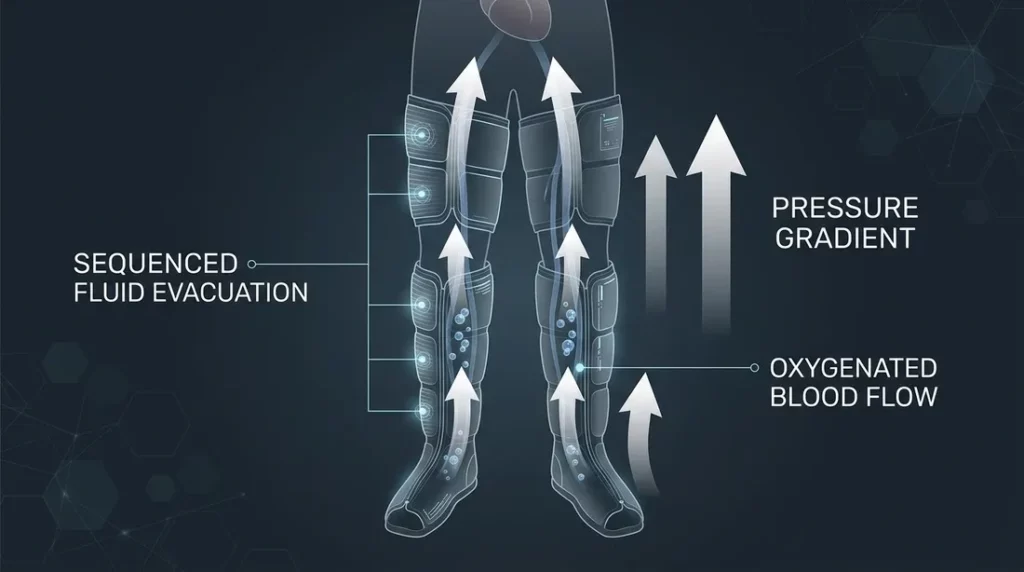
When I work on hydraulic systems, I look for smooth fluid flow. If there is a blockage, the system overheats.
Muscle recovery is essentially a “fluid management” problem.
🛠️ Technical Specialist’s Note: Penetration vs. Vibration
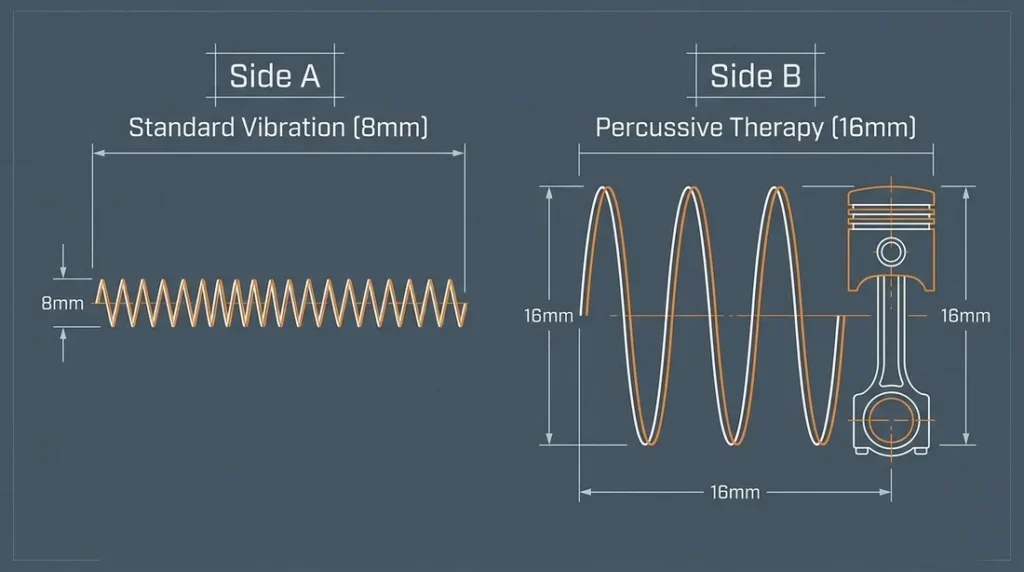
“In mechanical engineering, Amplitude is the distance a part moves. Most budget ‘massage guns’ are actually high-frequency vibrators with low amplitude (usually 8-10mm). They ‘buzz’ the skin but don’t reach the underlying structural tissue.”
- The 16mm Standard: Professional-grade percussive tools like the Theragun PRO have a 16mm amplitude. From a technical standpoint, this is the ‘Stroke Length’ required to reach deep-tissue knots and trigger a real neuromuscular release.
- Stall Force Diagnostics: Cheap motors stall (stop moving) the moment you apply pressure. High-torque motors allow you to ‘drive’ the tool into the muscle, ensuring the ‘Repair Signal’ reaches the intended depth without the motor overheating or losing frequency.”
— IndraP
Premium Tech for Quantifiable Muscle Healing
If you want the highest ROI on your “Uptime,” these tools provide the data you need to verify your healing.
🏆 The “Biometric” Leader – Theragun PRO Plus
Why it matters: This is the first massage gun with a built-in biometric sensor. It tracks your heart rate while you treat your muscles, providing a digital bridge between physical therapy and neurological recovery. It even includes Near-Infrared LED therapy to boost cellular healing.
💎 The Fluid Specialist – Normatec 3 Legs
Why it matters: Normatec uses patented Pulse technology to provide dynamic air compression. It is the gold standard for “quantifiable flushing,” helping Runners and home gym enthusiasts reduce swelling and DOMS with laboratory precision.

Frequently Asked Questions
Q: Can I use a massage gun every day?
Yes, provided you are tracking the tissue response. If a muscle feels “bruised” or your Readiness Score is trending downward despite daily use, you may be over-stimulating the area and need to switch to Passive Recovery like heat or compression.
Q: Are “Smart” recovery tools worth the premium price?
For a beginner, a standard foam roller is fine. But for a professional or senior who needs to minimize “down-time” and maximize safety, the data provided by tools like the Theragun PRO Plus ensures you aren’t doing more harm than good. Check our guide on Smart Muscle Recovery Tools and Apps for a deeper dive.
🚀 The ‘System Restore’ Protocol: How to Verify Healing
- 🔳 Check Resting Heart Rate (RHR): If your RHR is 5+ beats higher than your baseline, your ‘Engine’ is still running hot and needs more Passive Recovery.
- 🔳 Perform the ‘Soreness Scan’: Use a foam roller to find ‘Trigger Points.’ If a muscle is tender to the touch (Level 7+), it is not yet structurally sound for a heavy session on your Weight Bench.
- 🔳 The HRV Morning Review: Before you train, check your HRV. If it hasn’t rebounded to within 10% of your average, your nervous system hasn’t finished its ‘Repair Cycle.’
Conclusion – Data Closes the Loop
Your fitness journey is a loop: Training leads to Fatigue, and Recovery leads to Growth.
By quantifying your recovery with tech, you close that loop with data rather than hope.
You will know exactly when your “biological hardware” is repaired and ready for the next heavy session on your Home Strength Equipment.
The final piece of the puzzle is taking all this data—your progress, your recovery, and your bio-metrics—and using it to set goals that actually adapt to your life.
The Final Chapter – Adaptive Goals
Setting Adaptive Fitness Goals →
About IndraP
IndraP is the founder of Reliable Home Fitness and a Technical Equipment Specialist. Specializing in high-end recovery tech, he bridges the gap between mechanical engineering and human performance.
With unique expertise in bio-metric feedback and sensor accuracy, Indra helps you cut through the marketing noise to find tools that provide real, scientific value.