
In my world of technical diagnostics, if a machine has a weak fuel injection system, it doesn’t matter how powerful the motor is—the system will never reach its potential.

Your lungs are your body’s fuel injection system.
Most beginners focus only on their muscles, but those muscles cannot function without efficient oxygen delivery and carbon dioxide removal.
By tracking respiratory metrics, you can identify if your lungs are the “bottleneck” in your Modern Fitness Progress.
In This Guide:
💡 What is VO2 Max and why should I track it?
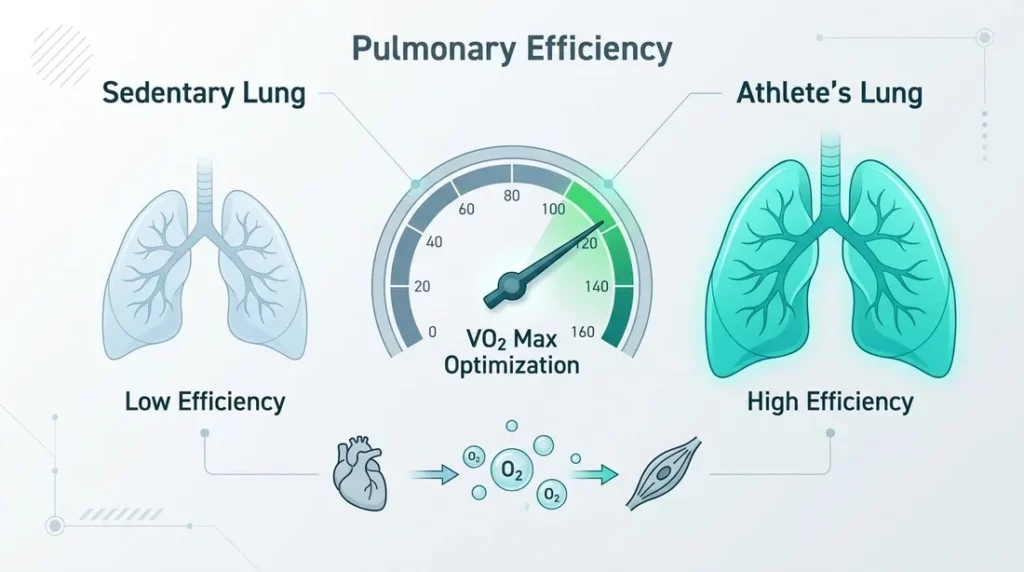
VO2 Max is a measurement of the maximum amount of oxygen your body can utilize during intense exercise. It is the single best indicator of cardiovascular fitness and long-term longevity. For home athletes, tracking your VO2 Max through advanced activity trackers with breathing analysis allows you to see if your Rowing Machine Workouts or Interactive Fitness sessions are actually making your heart and lungs more efficient.
🔥 Fuel Diagnostic – Are You Burning Fat or Carbs?
In 2026, we no longer guess our metabolism; we measure it through Gas Exchange Analysis. This is known as Metabolic Flexibility.
- The CO2 Signature: By measuring the concentration of Carbon Dioxide in your exhaled breath, modern sensors can determine your Respiratory Exchange Ratio (RER).
- Why it matters: If you are out of breath too early during a Rowing Machine session, it’s often because your body is stuck burning carbs and producing too much CO2, rather than efficiently burning fat.
IndraP’s Advice: Tracking your breath metrics helps you ‘re-tune’ your engine to burn fat more efficiently, increasing your endurance without adding more ‘strain’ to the system.

Tracking Respiratory Rate for Performance
While your heart rate is the most common metric, your Respiratory Rate (brpm)—the number of breaths you take per minute—is often a more sensitive indicator of impending fatigue.
For the 40+ professional or the Senior focused on lung health, a sudden increase in resting respiratory rate is a major red flag.
It often indicates that your body is fighting off inflammation or that your Readiness Score is about to drop.
✅ Critical Respiratory Metrics
- SpO2 (Pulse Oximetry): Measures the oxygen saturation in your blood. Essential for ensuring safe intensity during HIIT workouts.
- Inspiratory Muscle Strength: How much pressure your diaphragm can generate. This can be tracked and improved using Respiratory Trainers.
- Metabolic Flexibility: Tracking whether your body is currently burning fats or carbohydrates for fuel based on your CO2 output.
IndraP’s Technical Note – The Accuracy of Respiratory Sensors

When I diagnose a gas-fired boiler, I look at the exhaust to see the efficiency of the burn.
Modern fitness tech does something similar with your “exhaust” (your breath).
🛠️ Technical Specialist’s Note: Solving “Respiratory Jitter”
“When I analyze a waveform, I look for ‘jitter’—unwanted variations in the signal. Most wearables estimate your breathing using Respiratory Sinus Arrhythmia (RSA)—they look for tiny changes in your heart rate as you inhale. While clever, this is an ‘inferred’ data point and can be highly inaccurate during high-intensity HIIT Workouts.”
- The Direct Path: For true performance data, you need to measure Inspiratory Pressure. This is why I recommend dedicated hardware like the Airofit Pro.
- Signal Noise: If your watch is loose or you have poor peripheral circulation, the RSA signal becomes ‘noisy.’ For seniors or professionals focused on lung health, a direct-breath diagnostic is the only way to ensure your ‘Fuel System’ is actually improving.”
— IndraP
Premium Tools for Metabolic and Lung Tracking

To truly optimize your performance, you need to go beyond the watch on your wrist.
These tools provide lab-quality data in your own home.
🏆 The Metabolic Dashboard – Lumen Metabolic Tracker
Why it matters: This device measures your CO2 output through a single breath. It tells you if your body is currently burning fat or carbs, allowing you to track how your Home Exercise Bike sessions are improving your “Metabolic Flexibility.”
💎 The Performance Lung Trainer – Airofit PRO 2.0
Why it matters: This is a smart respiratory trainer that tracks your vital lung capacity and inspiratory strength in real-time. It provides a technical data set for your Breathing for Workout Recovery, ensuring your “Fuel System” is always upgraded.
Frequently Asked Questions
Q: Can I improve my VO2 Max at any age?
Absolutely. While the peak potential decreases slightly with age, seniors can see massive improvements in VO2 Max through consistent Cardio for Heart Health. Tracking this metric is the best way to prove that your “biological age” is lower than your chronological age.
Q: Is SpO2 tracking during sleep important?
Yes. For the professional under high stress, tracking SpO2 during sleep can help identify issues like shallow breathing or apnea. If your levels consistently drop below 90% during sleep, it will ruin your Muscle Recovery.
🚀 The Lung Performance Protocol
- 🔳 Establish your VO2 Max Baseline: Use a premium tracker to find your starting point. (Aim for ‘Good’ or ‘Excellent’ for your age bracket).
- 🔳 Test your ‘Vital Capacity’: Once a week, use a respiratory trainer to measure how many liters of air your lungs can actually move.
- 🔳 Monitor ‘Sleep Respiration’: Check your overnight respiratory rate. A sudden spike (e.g., from 14 to 18 breaths per minute) is a technical early-warning sign of overtraining or illness.
Conclusion – Upgrade Your Intake
Don’t let your respiratory system be the “weak circuit” in your fitness journey.
By tracking metrics like VO2 Max and respiratory strength, you ensure your heart and muscles are getting the oxygen they need to perform.
Now that we’ve covered the biological data, it’s time to look at the “Logbook”—how to track the actual weights, reps, and miles that build your strength.
Next Step – The Performance Log
From Notebooks to AI – Logging Gains →
About IndraP
IndraP is the founder of Reliable Home Fitness and a Technical Equipment Specialist. Collaborating with industry leaders like FoliageField.com, he specializes in identifying top-tier training equipment.
With unique expertise in board-level repairs and upgrades, Indra looks beyond the marketing hype to test the internal mechanics of the machines he reviews. His mission is to help you invest in gear that is safe, durable, and reliable.