
If you work out at a commercial gym, you leave the building after your session.
You drive home, giving you time to decompress.
But when you work out at home, your “commute” is walking 10 feet from your living room mat to the kitchen.
This proximity is your biggest strength (easy access to protein) and your biggest weakness (easy access to snacks).
Here is the hard truth: Willpower is a battery.
It drains throughout the day. By 8:00 PM, after work and a workout, your willpower is at 0%. If there are cookies on the counter, you will eat them.
You don’t need more discipline; you need a better system. Psychologists call this Environment Design, based on the principle that your surroundings dictate your habits more than your willpower does.
In this guide, we will “Rehab” your kitchen—rearranging your fridge and pantry so that the healthy choice becomes the path of least resistance.
?️ The Rules of Design
- The Visibility Rule: We eat what we see. Healthy food must be at eye level; junk food must be hidden.
- Create Friction: Increase the number of steps required to eat a bad snack (e.g., put it on a high shelf in an opaque jar).
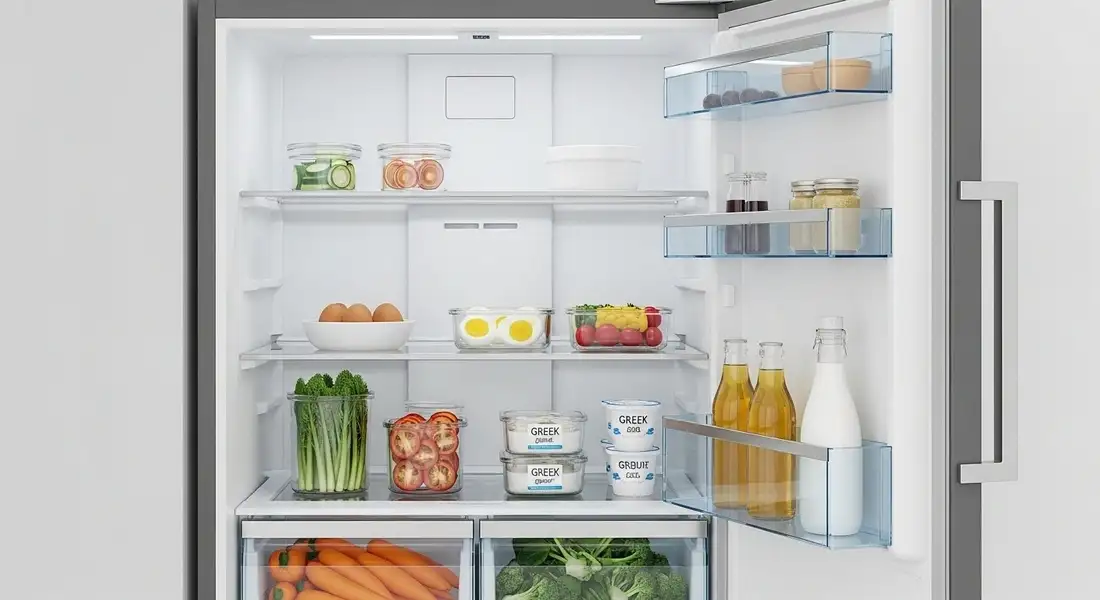
- The Power Shelf: Your fridge needs a dedicated zone for “Ready-to-Eat” protein.
- Prep is King: You are more likely to eat chopped fruit than whole fruit.
Step 1 – The “Traffic Light” Audit
Before you organize, you must audit. Go through your pantry and fridge and categorize foods into three buckets.
- ? Green Light (Eat Anytime): Vegetables, Fruits, Lean Protein, Water.
- ? Yellow Light (Eat Sometimes): Nuts, Rice, Pasta, Cheese, Bread.
- ? Red Light (The Triggers): Chips, Cookies, Soda, Candy.
The Strategy
- Green: Must be visible immediately.
- Yellow: Must be in containers/drawers (not loose).
- Red: Ideally, do not buy them. If you must have them (for kids/spouse), they go in the “Inconvenient Zone.”
Step 2 – The Fridge “Power Shelf”
Most people organize their fridge by category (Dairy, Meat, Veg). This is wrong for weight loss.
You should organize by Goal.
The Middle Shelf (Eye Level) is Prime Real Estate.
Do not waste this space on leftovers or milk. This is your Power Shelf.
What is a “Power Shelf”?
The Power Shelf is the middle shelf of your refrigerator, located directly at eye level. To support body recomposition, this shelf should contain only high-protein and high-fiber snacks that are ready to eat (e.g., Greek yogurt, hard-boiled eggs, sliced peppers). By placing these items here, you make the healthy choice the automatic choice when you open the door.

Step 3 – Creating “Friction” in the Pantry
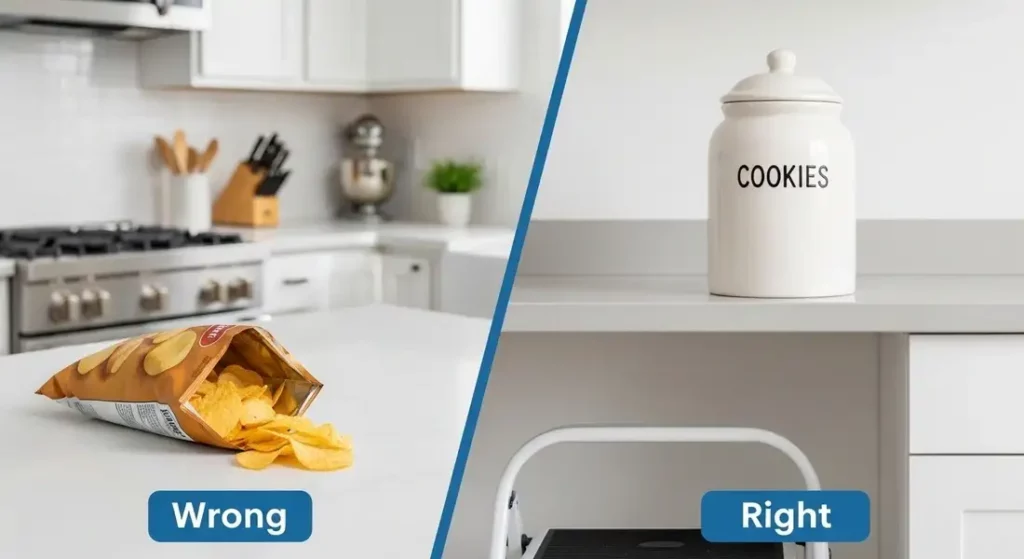
Friction is the effort required to do a task. We want to increase friction for bad habits.
- The Problem: A bag of chips on the counter has Zero Friction. You grab it without thinking.
- The Fix: Put the chips in an Opaque (Solid Color) Bin on the highest shelf.
- Result: To eat them, you have to get a step stool and open a lid. That 10-second delay forces your brain to ask: “Am I actually hungry, or just bored?”
? The Instant Pantry Swap
- Crave Crunch? Swap Potato Chips → Air-Popped Popcorn or Rice Cakes.
- Crave Sweet? Swap Cookies → Dark Chocolate (70%+) or Frozen Grapes.
- Crave Soda? Swap Coke → Sparkling Water with a splash of Lime.
The Tool You Need: Clear bins for healthy stuff, Opaque bins for treats.
? Editor’s Choice – Organization
Why we picked them: If you can’t see the healthy food, you won’t eat it. Clear bins force you to acknowledge your inventory, prevent over-buying, and make your pantry look like a professional setup (which motivates you to keep it clean).
Step 4 – The Meal Prep Container Upgrade
If you cook a healthy meal but store it in a stained, warped plastic tub without a lid, you won’t want to eat it later. Presentation matters.
Switching to Glass Containers changes the psychology of leftovers. They look appetizing, they don’t stain, and you can microwave them safely.
? Editor’s Choice – Food Storage
Rubbermaid Brilliance Glass Storage Set
Why we picked it: These are the gold standard. They are 100% leak-proof (you can toss soup in your gym bag), crystal clear, and stack perfectly. Unlike plastic, glass doesn’t hold onto old food smells.

Step 5 – The “Hydration Station”
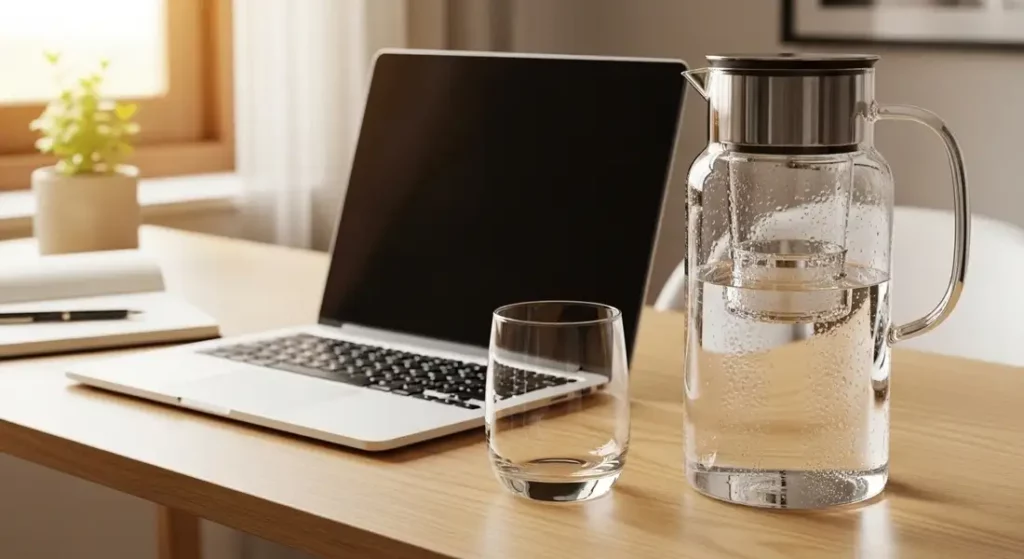
We often mistake thirst for hunger. If your water is hidden, you won’t drink it.
- The Hack: Keep a large, filtered water pitcher on your desk or kitchen counter—NOT inside the fridge.
- Why: Room temperature water is easier to chug, and having it visible acts as a visual trigger.
Want to know exactly how much water you should drink? Check out our full Hydration Guide for Home Workouts.
Frequently Asked Questions
Q: What if my family eats junk food?
Establish a “One Cabinet Rule.” Designate one opaque cabinet for their snacks. You do not open that cabinet. If their snacks are left on the counter, put them back in the “Junk Bunker.”
Q: Should I prep meals for the whole week?
For beginners, 7 days is overwhelming. Try the “Buffet Prep” method: Cook a big batch of protein (chicken/tofu) and a carb (rice/quinoa) on Sunday. Mix and match them with fresh sauces during the week for variety.
Q: Are frozen vegetables okay?
Yes! They are often more nutritious than fresh because they are flash-frozen at peak ripeness. They are also cheaper and require zero chopping. Keep your freezer stocked for emergencies.
Conclusion
Your environment dictates your choices. By spending one Saturday afternoon “rehabbing” your kitchen, you remove the need for constant willpower.
Now that your kitchen is set up, let’s fill it with the right fuel. It’s time to understand the building blocks of your diet.
Step 3: Master the Basics
Read Chapter 3: Protein, Carbs & Fats Guide →
About IndraP
IndraP is the founder of Reliable Home Fitness and a Technical Equipment Specialist. Collaborating with industry leaders like FoliageField.com, he specializes in identifying top-tier training equipment.
With unique expertise in board-level repairs and upgrades, Indra looks beyond the marketing hype to test the internal mechanics of the machines he reviews. His mission is to help you invest in gear that is safe, durable, and reliable.