
You’ve been disciplined.
You’ve been doing your push-ups, squats, and lunges for a month.
You feel a little stronger, but when you look in the mirror, things look… mostly the same.

Or worse, your wrists are starting to ache, and your knees feel “crunchy.”
Is bodyweight training a waste of time?
Absolutely not.
However, there is a massive difference between “exercising” (moving to burn calories) and “training” (moving to build muscle).
When we strip away the heavy weights of the gym, we lose the easiest metric for progress (adding plates to a bar).
This makes it incredibly easy to fall into invisible traps that stall your growth.
In this guide, part of our Ultimate Guide to Bodyweight Workouts at Home, we are going to troubleshoot the four biggest bodyweight training mistakes beginners face—and give you the tools to fix them instantly.
Quick Troubleshooting Guide
- Problem: No muscle growth? Fix: You are moving too fast. Slow down your reps.
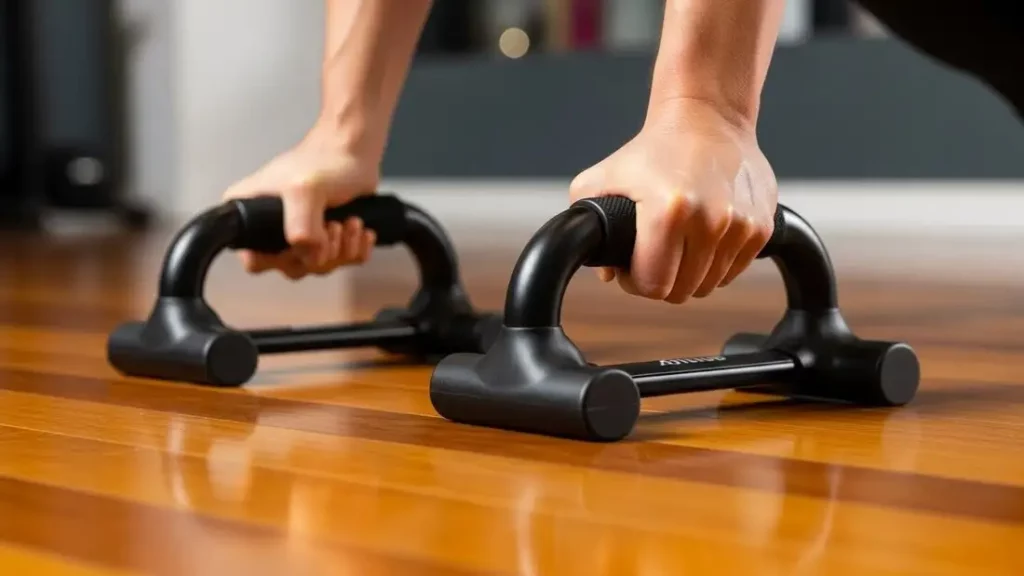
- Problem: Wrist pain? Fix: Use push-up bars to straighten the joint.
- Problem: It feels too easy? Fix: You aren’t using progressive overload.
- Problem: Constant soreness? Fix: You are overtraining; take a rest day.
Mistake #1 – The “Junk Volume” Trap (Speed vs. Tension)

The most common mistake beginners make is chasing high numbers.
You might think, “If I do 50 push-ups, that’s better than 10, right?”
Not necessarily.
If you are bouncing off the floor, using momentum, and letting gravity do half the work, you are performing what coaches call “Junk Volume.”
You are building endurance (cardio), but you aren’t stimulating the muscle fibers enough to trigger growth.
The Fix – Time Under Tension (TUT)
Your muscles don’t count reps; they sense tension.
To make bodyweight exercises effective, you must slow down.
- The 3-1-1 Tempo: Lower yourself for 3 seconds. Pause at the bottom for 1 second. Explode up for 1 second.
- The Result: 10 reps done this way will feel harder than 50 fast reps. This is how you build muscle without weights.
Deep Dive: Mastering your breath is the secret to controlling your tempo. Read our guide on Breathing For Bodyweight Exercises – Powering Through Your Workouts to learn how to sync your breath with movement.
Mistake #2 – Ignoring Joint Pain (Wrists & Knees)
“No pain, no gain” is terrible advice for your joints.
Bodyweight moves like push-ups, planks, and burpees put a significant amount of pressure on your wrists, forcing them into deep extension (bending back 90 degrees).
Similarly, lunges can tax the knees if your hips are tight.
The Wrist Fix
If flat-hand push-ups hurt, stop doing them. You are irritating the joint.
- Solution: Use a pair of Push-Up Bars / Parallettes. These inexpensive tools allow you to grip a handle, keeping your wrist neutral (straight like a punch) rather than bent. This instantly removes the strain so you can focus on your chest, not your pain.
The Knee Fix
Knee pain during squats or lunges often isn’t a knee problem—it’s a hip problem. If your hips are tight, your knees have to overcompensate.
- Solution: You need to mobilize your hips. Check out our Equipment-Free Hip Flexor Workout.
- Comfort Tip: If you work out on a hard floor, a thin yoga mat isn’t enough. Investing in a high-density, Thick Exercise Mat provides the cushion your knees need during kneeling exercises.
Mistake #3 – You Forgot to Progress (The Plateau)

The human body is an adaptation machine.
It adapts quickly to stress.
If you do 3 sets of 15 squats today, it triggers growth.
But if you do 3 sets of 15 squats next month, your body won’t change—because it has already adapted to that stress level.
This is called the Law of Accommodation.
In the gym, you just add 5 lbs. At home, you have to be smarter.
The Fix – 3 Ways to Overload Without Weights
- Decrease Rest: If you usually rest 60 seconds between sets, cut it to 30. You are doing the same work in less time (increased density).
- Increase Complexity: Move from a regular Squat to a Split Squat (one leg).
- Add External Load: You don’t need iron plates.
- Option A: A Weighted Vest is the ultimate bodyweight accessory. It adds 10-20lbs to your frame, making every squat, lunge, and push-up instantly harder.
- Option B: Use Resistance Bands. Wrap a band around your back during push-ups to add resistance at the top.
Related Read: Supercharge Your Workout – How to Combine Bands with Other Gear.
Mistake #4 – You Are Overtraining (Recovery)
Because bodyweight training “feels” lighter than heavy weights, beginners often think they should train every single day.
This is a mistake.
Muscles do not grow while you are working out; they grow while you are sleeping and recovering.
If you train the same muscles 7 days a week, you are breaking them down faster than they can rebuild.
The Fix – Schedule & Recovery
- Frequency: Aim for 3 to 4 workouts per week.
- Active Recovery: On off days, go for a walk or do some stretching.
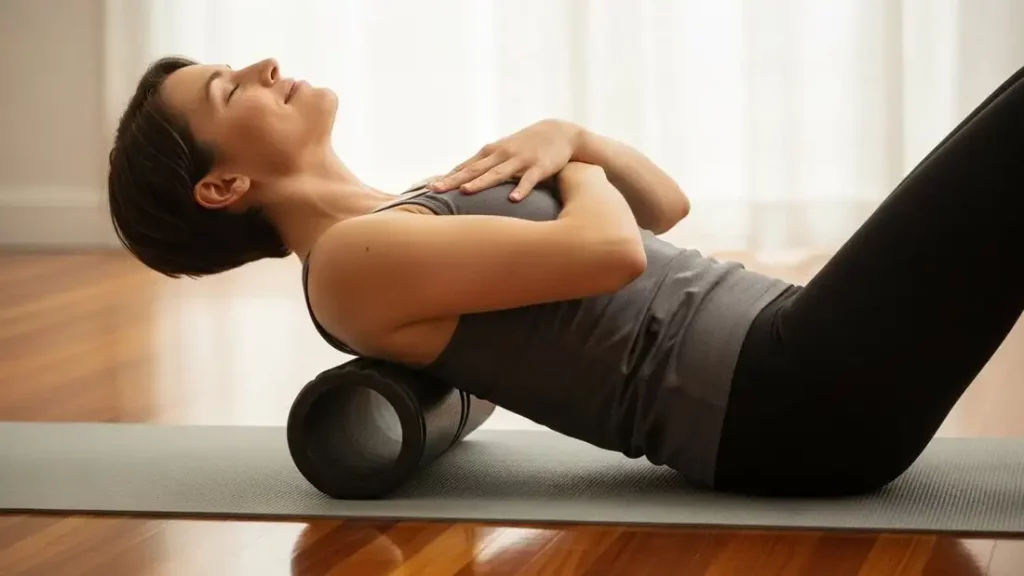
- Self-Massage: If you are feeling stiff, using a High-Density Foam Roller can help release tight fascia and improve blood flow, speeding up recovery.
Frequently Asked Questions
- Why do my wrists hurt during push-ups?
This is usually due to lack of wrist flexibility or putting too much weight on the heel of the palm. Using push-up handles or doing push-ups on your fists (knuckles) can keep the wrist straight and reduce pain. - I am sore every day. Is that good?
No. Constant soreness usually means you are overtraining or under-recovering (not sleeping or eating enough). You should feel energized, not destroyed. Take an extra rest day. - How do I make squats harder without weights?
Slow down the tempo (4 seconds down), pause at the bottom, or try single-leg variations like the Bulgarian Split Squat. - What if I can’t do a single push-up?
That is normal! Start with “Wall Push-Ups” (standing up leaning against a wall). As you get stronger, move to “Incline Push-Ups” (hands on a couch), and finally to the floor.
Conclusion – Train Smarter, Not Just Harder
If you aren’t seeing results, don’t quit. Just adjust your strategy.
- Slow down your reps (Time Under Tension).
- Protect your wrists and knees with the right accessories.
- Make the exercises harder over time (Progressive Overload).
Ready to apply these fixes?
Now that you know how to do the moves correctly, let’s look at the specific exercises you should be doing.
Head over to our next guide: Master the Basics – 5 Essential Bodyweight Exercises for Full-Body Strength.
Or, if you want to understand the science behind why this works, read Can You Build Muscle with Just Bodyweight? The Honest Truth & Science.
(Disclaimer: This content is for informational purposes only. Consult a physician before starting any new exercise program, especially if you have pre-existing health conditions.)