
Disclosure: As an Amazon Associate, I earn from qualifying purchases. This technical audit contains affiliate links which support our research at no cost to you.
Abstract: Traditional weightlifting utilizes fixed, balanced implements like barbells and dumbbells.
While standard lifting builds general muscular strength, it does not challenge active stabilizer coordination.
This technical audit compares the biomechanical demands of sandbag training versus weightlifting.
We analyze grip strength yield, joint stabilization metrics, and core shear-force protection.
1.0 Grip Strength Yield: Static Steel vs. Dynamic Canvas
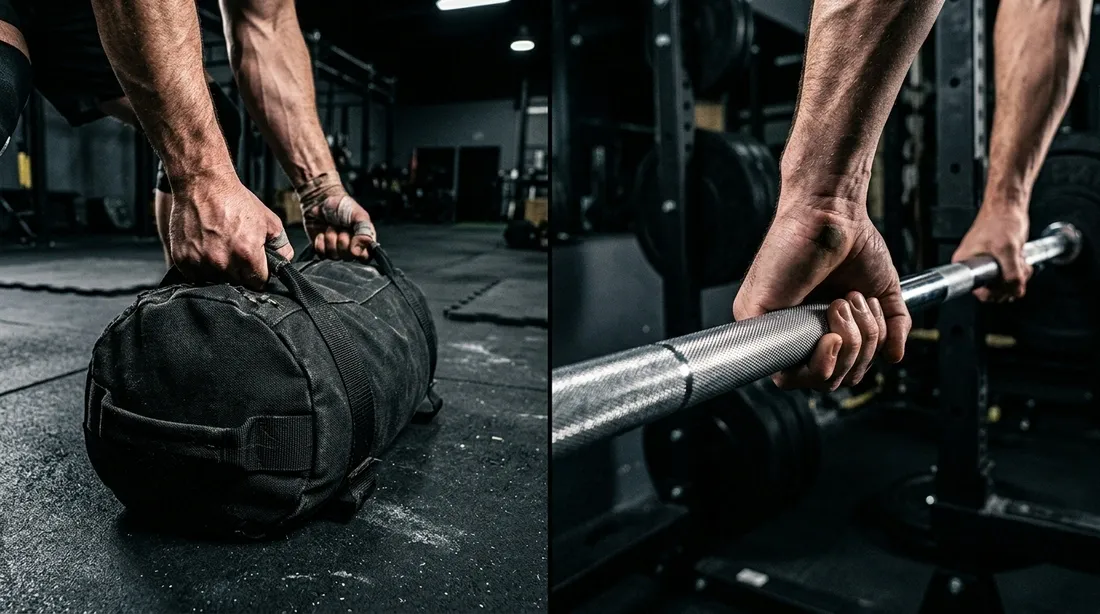
Lifting a barbell relies on a static, symmetrical grip.
The standard bar features texturized knurling designed to slide naturally into your palms.
This passive system requires limited active finger-flexor adaptation during lifts.
A training sandbag has no fixed shape, forcing you to grip shifting canvas folds.
This dynamic action recruits your deep forearm muscles and wrist stabilizers continuously.
Grappling with sandbags strengthens your grip, making everyday tasks easier and enhancing athletic performance.
2.0 Stabilizer Activation: The Spine Bracing Mechanism
When you lift a barbell, the weight remains balanced and predictable.
A sandbag’s center of gravity shifts constantly, requiring rapid postural corrections.
A comprehensive clinical trial published in the Journal of Strength and Conditioning Research evaluated strongman training implements (such as sandbags and heavy carries) against traditional barbell weightlifting programs.
The research demonstrated that lifting shifting, odd-object loads produces significantly higher trunk and deep core muscle activation compared to balanced bars.
Additionally, clinical research published by the National Institutes of Health (NIH) shows that progressive sandbag exercise training significantly enhances overall skeletal muscle strength and metabolic controls.
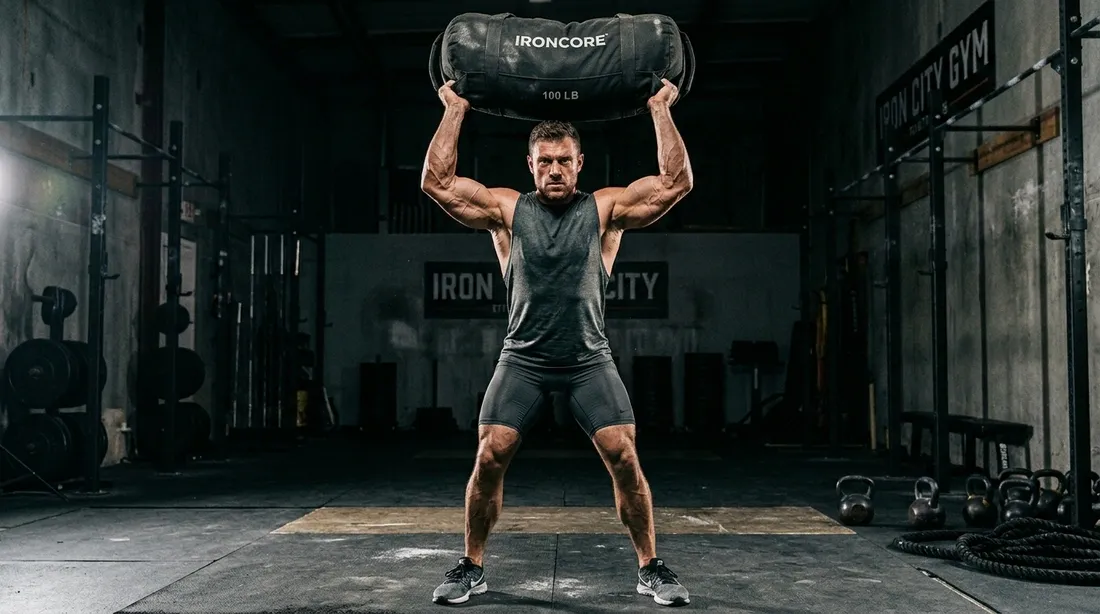
Lifting a sandbag overhead forces your wrist and shoulder stabilizers to hold the shifting weight steady.
This constant work builds strong, resilient joints that resist overuse injuries.
3.0 Traditional Weightlifting vs. Sandbag Training
This comparison table is responsive. Swipe horizontally on mobile to compare features:
| Feature & Comparison Vector | Dynamic Sandbag Training | Traditional Weightlifting |
|---|---|---|
| Equipment Versatility | Highly versatile; one tool covers multiple compound lifts | Requires various specialized machines, barbells, or free weights |
| Muscle Activation Pattern | Engages stabilizing muscle pathways due to shifting mass | Primarily isolates targeted prime mover muscle groups |
| Functional Strength Yield | Mimics real-world movement mechanics and dynamic objects | Highly focused on isolated and linear movement patterns |
| Spine & Joint Stress | Lower risk of localized compression; self-limiting load | Higher compressive risk if structural form is not maintained |
| Home Gym Cost Efficiency | Relatively low cost; minimal auxiliary equipment required | Can be expensive due to rack, barbell, and plate requirements |
4.0 Recommended Gear for Maximum Grip Training
To safely train your grip with unstable loads, you need a training bag with rugged, slip-free handles. We also recommend heavy-duty training gloves to protect your palms from friction burns during high-velocity carries.
REP Fitness Ballistic Sandbag
- 1000D Cordura canvas shell offers excellent grip texture
- Serrated rubber-molded handles prevent hand slippage
- Perfect weight distribution for crushing carry holds
Yes4All Workout Sandbag System
- Multi-handle layout provides diverse hand placements
- Thick canvas fabric challenges dynamic pinch strength
- Budget-friendly option to start unstable grip workouts
5.0 User Case Studies & Feedback Synthesis
Our research board synthesized real-world user feedback from athletes transitioning from barbell weightlifting to sandbag systems:
Clinical Case Feedback
“Since starting sandbag training, my everyday strength has changed. Carrying groceries, playing with my kids, and yard work feel significantly easier.”
“I used to struggle with lower back pain during squats. After incorporating unstable sandbag exercises, my core stability has improved and the dull ache is gone.”
“The cardiovascular demand of heavy carries is intense. It allows me to combine strength and high-intensity metabolic conditioning in my living room.”
6.0 Technical FAQ: Sandbag vs. Barbell
For functional conditioning and core stability, yes. However, barbells are still superior for lifting maximal, heavy weight because they are balanced and can hold far more plates.
No. Actually, sandbags allow your wrists to rotate naturally during movements. This is far more comfortable than a straight steel barbell, which locks your wrists into a fixed position.
Because there is no solid bar to rest your hands on. You must squeeze the shifting fabric continuously, which keeps your forearms and fingers working under constant tension.
